Boston City Council calls for city, state to pay to house Haitians facing deportation after TPS expiration
Published in News & Features
The Boston City Council unanimously passed a resolution calling for the city and state to provide housing for Haitian immigrants facing deportation due to the expiration of their temporary protected legal status in late July.
The Council voted, 12-0, Wednesday in favor of a resolution put forward by Councilors Miniard Culpepper, Ruthzee Louijeune and Henry Santana “urging the City of Boston and the Commonwealth of Massachusetts to provide emergency shelter for displaced former Haitian temporary protected status holders.”
“Our response cannot stop at legal assistance and employment support,” Culpepper said. “We also have to address the immediate humanitarian needs of residents, who may also lose their housing and have nowhere safe to go.”
The Department of Homeland Security announced the Trump administration’s decision to end TPS for Haitian immigrants last November, setting off a court battle that was resolved this past June, when the Supreme Court ruled in favor of ending the program that provides lawful status and protection from deportation.
More than 300,000 Haitian immigrants lost their legal status throughout the country following the ruling, including roughly 45,000 in Massachusetts, when the temporary protections expired on July 27, per the Council resolution.
“The loss of work authorization, income, and housing stability puts former TPS holders and their families at greater risk of eviction, overcrowding, displacement, and homelessness,” Culpepper said.
The Council is calling on the sanctuary city and state governments to shield now-illegal Haitian immigrants from deportation by converting public buildings into emergency shelter facilities for those unable to pay for their own housing.
“Safe shelter is a fundamental human need, and no Boston resident should be forced to sleep outdoors, remain in an unsafe or overcrowded living arrangement, or face family separation because the termination of a federal immigration designation has deprived them of employment or housing stability,” the resolution states.
“The City of Boston and the Commonwealth of Massachusetts own, control, or have access to public buildings and facilities, some of which may be vacant, underutilized, or capable of being temporarily converted into emergency shelter while complying with all applicable fire, building, health, sanitation and accessibility requirements,” the resolution adds.
Councilors did not say how much it would cost the city or state to house potentially thousands of former Haitian TPS holders, but at least one council member, Julia Mejia, stated her intention to push for funding for that purpose in the city budget.
“I will continue to stand in solidarity with the Haitian community,” Mejia said. “This resolution affirms the city’s commitment to protect and support impacted residents. And so, we’re urging the Council to step up and make sure when it’s time for budget season that the rhetoric that we speak reflects the budget votes that we take.”
The city had to dip into its emergency reserve fund to cover a $70 million budget shortfall in the last fiscal year that ended June 30.
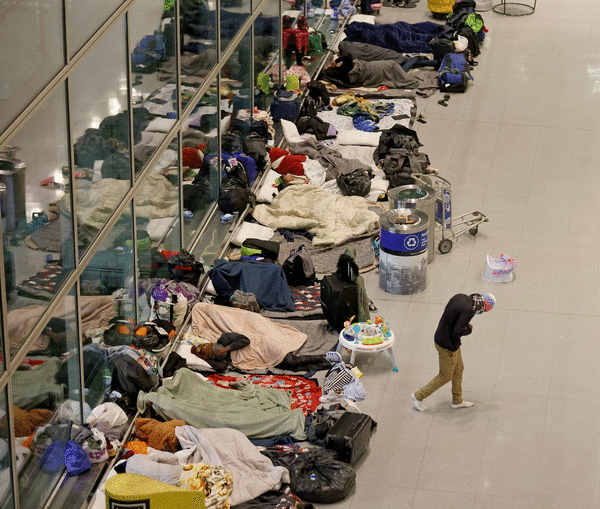
The Healey administration spent $978 million on the state’s emergency family shelter program in fiscal year 2025, spending that was largely driven by a surge in immigration that had new arrivals sleeping at Logan Airport while awaiting shelter.
Louijeune, the first Haitian-American to be elected to the Council, indicated things may be trending that way again when emotionally recounting how she had to respond to a “crisis situation” at Logan Airport Tuesday night that kept her away from home until 1 a.m. Wednesday.
“People are really suffering, and I try to articulate how much people are suffering. I don’t talk about it all the time, but people are really suffering,” Louijeune said. “And so, whatever we can do to help people who are suffering, whether it’s shelter that they need, whether it’s mental health issues — People are in crisis, and they need our help.”
The Council’s idea to provide emergency housing at seemingly no cost to Haitian immigrants without legal status comes during a housing crunch in the city, where many residents are struggling to pay rent and find homeownership out of reach.
Nearly half, or 49%, of all renters in Greater Boston were classified as cost-burdened in 2024, meaning they spend more than 30% of their gross monthly income on housing costs, according to the 2025 Greater Boston Housing Report Card published by the Boston Foundation.
The same report card shows the yearly income needed to afford a “starter home” in Greater Boston was $162,224 in 2025, compared to $97,941 in 2021. The entry-level home price during that time shot up from $399,554 in 2021 to $505,319 last year, per the Boston Foundation.
The Council resolution states that TPS “allowed Haitian nationals to lawfully remain and work in the United States because political instability, widespread violence, natural disasters, humanitarian crises, and the limited capacity of the Haitian government made their safe return impossible.”
TPS for Haiti was first designated by the U.S. government in January of 2010 following an earthquake that struck the country, and was repeatedly extended since that time due to ongoing instability.
While TPS has ended, councilors argued that the city, which provides sanctuary protections for illegal immigrants under the Boston Trust Act, should continue to shield Haitians from federal immigration enforcement by providing housing, legal assistance and employment support.
“The termination of TPS for Haitian immigrants has created real uncertainty, instability, and fear for residents in our city,” Mejia said. “There’s an opportunity for us to use Boston resources to help fulfill the potential to address the crisis and fill the gap, and that includes occupying empty spaces.”
Santana added, “We cannot control federal policy, but we can control what we do within our own resources.”
________
©2026 MediaNews Group, Inc. Visit at bostonherald.com. Distributed by Tribune Content Agency, LLC.






Comments