Minnesota colleges brace for an enrollment 'cliff.' But will it really happen?
Published in News & Features
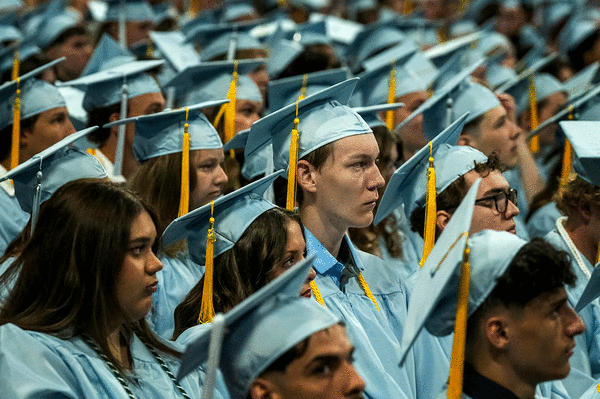
The idea that there will be a sharp, menacing dropoff in high school graduates that will have dramatic effects on college and university enrollment has often been repeated in higher education circles in recent years.
But will there be an actual “demographic cliff” over the next 15 years, and should leaders make big changes to prepare for it? The answer depends on how “cliff” is defined, whom you ask and what data is used. And Minnesota’s fate, many experts agreed, will be different than the national picture.
The demographic cliff narrative says that, because the number of babies born in the U.S. declined starting in 2008 due to the Great Recession, there are fewer 18-year-olds graduating from high school now and in the years to come.
Some say the college enrollment decline has already begun, others say 2026 is the first year and still others claim it hasn’t started yet. Regardless, it is supposed to continue through 2041, when the count of high school grads will have fallen by around 13% nationally, the Chronicle of Higher Education said.
But some experts say the change won’t be nearly as bad as predicted and others don’t think it will take place at all.
“To experience a double-digit enrollment decline would be highly disruptive,” said Nathan Grawe, a Carleton College economics professor, citing Minnesota’s projected loss of 12%. “If institutions … think, oh, we can just continue doing exactly what we’ve been doing and it’s going to be a comfortable path for us in the next 20 years, I would say I strongly doubt that.”
This prediction has caused considerable concern, with some school leaders saying it’s why they must make various cuts and changes. Other times, it’s mentioned in a long list of factors officials say are contributing to an impending crisis, such as AI’s influence, declining funding, rising tuition costs, ballooning student debt and public doubt about a college degree’s value.
Recently, leaders from both Minnesota State Colleges and Universities and the University of Minnesota have said either that they need to “right-size” their system, likely closing campuses, or reduce annual budgets by at least $225 million over two years.
Both the U and Minnesota State systems, along with 18 private schools, saw flat enrollment this fall after several years of increases.
Dan Currell, a Gustavus Adolphus College trustee who once worked for the U.S. Department of Education, calls the cliff “hogwash.”
“There’s definitely no cliff projected — there’s ups and downs,” Currell said. “It’s a monster in the closet that doesn’t exist.”
Many people objected to the ominous word “cliff,” saying the problem is partly semantics.
“It’s kind of more of a gentle slope, downward slope, than a cliff,” said Susan Brower, the state demographer, adding that “cliff” may be too dramatic.
Colleges confront enrollment decline
Experts who say there’s an enrollment cliff also believe that many institutions will need to transform to survive.
Grawe, who said the cliff isn’t quite here yet, said a 16.5% dip nationally in births starting 18 years ago will soon cause struggles.
A study of northeastern U.S. colleges showed that, if net revenue from students declined by 10%, then one-third of the campuses would run out of money in 10 years.
“[Cuts] just get tougher and tougher unless you can figure out, OK, so how do we recruit a larger share of these students or how do we retain the students we bring to college the first time?” Grawe said.
Expanding college access is key, he said. Different kinds of colleges will see varying effects, he said, with flagship public universities and selective private liberal arts colleges faring best.
“[Colleges] will not just walk off the cliff,” Grawe said. “They will change how they teach, how they recruit, who they serve.”
While there’s time to adjust, it’s an unprecedented challenge for the country, he said.
At the U, Jack Miner, the vice president for strategic enrollment management, said Minnesota will be better off than elsewhere in the Midwest, which will also see a 16% decline overall.
Minnesota is already doing what it should to prepare by aiming to get more high school graduates to attend college and adults with some college to finish their degree, helping the state’s workforce and their own job prospects.
“Close to 40% of high school graduates right now are not going to college, so we have … graduates available,” Miner said.
The state’s investment in financial aid and “dual enrollment” programs, where students can try out college while in high school, will create more affordable pathways to college for more Minnesotans, he said.
Plans are underway to better promote the U’s five campuses, encouraging Minnesotans to go to school locally. The U is also creating an online hub so adult learners have more opportunity to take online classes, Miner said.
Fewer high school graduates
Others said the enrollment outlook won’t be as detrimental as forecasted, that things could still change and schools can, or will, adapt.
Brower believes there will be enrollment losses at colleges in the U.S. and Minnesota but thinks they’re not as alarming as some others do.
A shrinking pool of high school graduates will exert pressure on colleges, she said.
State projections show that numbers of 18- and 19-year-olds will stay steady through 2032, decline between 2033 and 2037 and remain about 10,000 people short of current totals until 2040. Migration from other states and nations has helped offset the effects of declining births so far, but maintaining the young adult population would require ongoing migration.
Colleges do need to face the reality of declining enrollment, she said, and “shifting out of a growth mindset is what we can be doing now.” But she said factors used in enrollment projections could change between now and 2040.
International immigration could increase and help colleges, and climate change could create new U.S. migration patterns, she said.
Colleges will have to reorganize to attract a broader group, including perhaps more older adults or international students, she said.
“Can you find a pool of people who need education and meet them where they’re at?” she said.
Paul Cerkvenik, president of the Minnesota Private College Council, said there’s a small decline in college enrollment coming for Minnesota, but numbers will dwindle less here than anywhere in the U.S. except the South between now and 2035. For the five years after that, the state will see a 10.5% shrinkage in college students.
Minnesota’s thriving economy means the state will fare better than elsewhere, he said.
But Cerkvenik said higher ed faces other challenges that are more significant than any enrollment decline. The state saw a 10% decline in the percentage of high schoolers headed to college between 2013 and 2023. And the number of students leaving Minnesota for college is consistently between 18% to 20%. Those trendlines could improve, he said, and colleges can work on them.
He said he’s confident that Minnesota’s private schools will adjust.
“Small nonprofit colleges ... have to adapt to the changing environment all the time and they can be nimble and responsive,” he said. “They’ve been through ups and downs for 150 years.”
A made-up crisis?
Several education experts said they don’t believe a cliff will occur at all.
Neil Kraus, a University of Wisconsin-River Falls political science professor, says doomsday predictions are overblown. Projections often cited to support it, like birth rates or high school graduates’ numbers, have so many variables that they’re difficult to predict beyond a few years out, he said.
He said only predictions of college enrollment, like those from the National Center for Education Statistics, are relevant, since people attend college at different ages, not just right after high school.
Kraus also said the cliff is part of a larger manufactured crisis in higher ed. The theory is perpetuated by Republicans, he said, who want to cut funding and programs and companies who hope to sell new products and consulting services to colleges.
Currell said that nationally, high school graduates hit a high point in 2026, but that by 2036, numbers will decline back to 2018 levels. Looking at the trajectory as a whole means there’s no cliff, he said.
“The cliff hyperbole only looked at the downside and ignored the rise,” he said. “There will be fewer 18-year-olds slightly, year over year, into the future but ... it’s projected to level out in the 2040s and 2050s.”
Conditions could also change. If an unexpected recession occurs, a higher enrollment rate could single-handedly spike college attendance quickly, since people usually go to school during those times, he said.
“This is just kind of another twist in demographics that honestly isn’t nearly the change that people think it is,” Currell said.
©2026 The Minnesota Star Tribune. Visit at startribune.com. Distributed by Tribune Content Agency, LLC.





Comments