Angela Alsobrooks seeks greater influence as Senate Democrats pick leaders
Published in News & Features
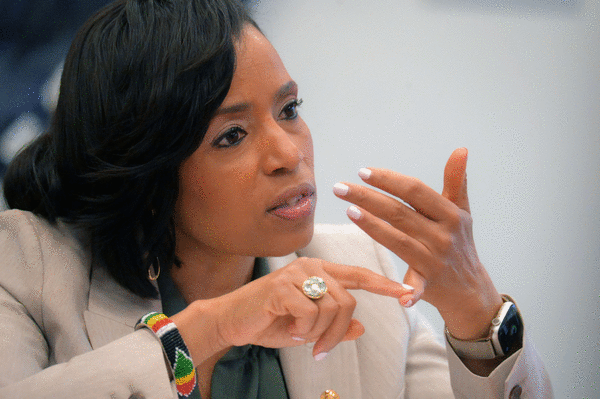
U.S. Sen. Angela Alsobrooks spent much of the midterm campaign season traveling the country to help Democrats win competitive races. Now, the Maryland Democrat says she wants a bigger role in the party’s Senate leadership. However, she doesn’t have her eye on the Senate majority leader position, which her Maryland counterpart, U.S. Sen. Chris Van Hollen, has expressed interest in.
“I want Marylanders to have as much say at these tables as possible, so I absolutely have an interest in serving at the leadership table,” Alsobrooks told The Baltimore Sun. “I want my constituents’ voices to be heard loud and clear at these tables on issues like preserving funding for the Chesapeake Bay, fighting hard to get the FBI headquarters here, and making sure that we’re fighting for every resource.”
Democrats made major gains in the midterms last week and are poised to hold a 56-seat Senate majority in the next Congress. In an interview with The Sun, Alsobrooks discussed her campaign travels, her ambitions within the Senate Democratic caucus and how she hopes to use those relationships to advance priorities for Maryland.
Alsobrooks’ ambitions put Maryland at the center of conversations shaping national leadership, potentially giving the state unique bargaining power.
The Senate Democratic caucus is scheduled to begin leadership discussions Tuesday.
This conversation has been edited for brevity and clarity.
Q: You campaigned for Democrats across the country this year. Why was it important for you to help candidates in other states?
A: We had a map showing the places we absolutely needed to win to gain the majority, including Ohio, North Carolina, Michigan, and Georgia. I also thought there were opportunities I didn’t want us to overlook, places like Mississippi, where I was literally the first senator to campaign with Scott Colom. Scott Colom’s campaign manager also worked on my Senate campaign, and he’s the person who called me and said, “Listen, you’ve got to get to Mississippi. We have a real shot here. I have a candidate worth meeting.”
Q: You campaigned for candidates in states where Democrats have struggled to win. What did you see in Scott Colom in Mississippi and Angie Nixon in Florida that made you think they were competitive?
A: If you look at Scott Colom as a candidate, we hadn’t elected an African American in Mississippi in over 100 years. Angie Nixon (in Florida) did an outstanding job and got really close. I think they proved everyone wrong when we met them and saw how aggressive they were on the ground. We now know, going forward, for 2028, that we have a hell of a shot at some of these places we’ve never had before.
Q: How did you use your relationships and networks to help those campaigns?
A: When I went to Georgia for Sen. Jon Ossoff, I assembled a really robust event with Black women. I’m a member of a couple of organizations, and a number of women from those organizations showed up. I did the same thing in Ohio, where I co-hosted a Divine Nine event for Sen.-elect Sherrod Brown, bringing out some of the (historically Black) sororities and fraternities.
Q: You were campaigning for candidates with different backgrounds and constituencies. How did you connect with voters who might not have seen themselves in those candidates?
A: For most of these candidates, I represent more than just a Black woman. I was raised by two working-class parents, a car salesman and a receptionist. And believe it or not, when I go into these places, I don’t go anywhere and say I’m a Black woman. I think that’s like self-evident. The thing I’ve been able to talk about is that the gulf is growing between the American people and the American dream. I talked about being a caregiver to my two parents who were very sick over the last year, and what it meant to be a mother to a 21-year-old who feels really concerned about whether she’s going to be able to afford a home as she gets older. So when I went out on behalf of my colleagues, I wasn’t limited to talking to people as a Black woman.
Q: How could the relationships you built on the campaign trail help you advance legislation for Maryland?
A: These relationships mean everything. I think it is an opportunity when you campaign nationally to develop the kinds of relationships that help me to be successful on behalf of my constituents.
_____
©2026 Baltimore Sun. Visit baltimoresun.com. Distributed by Tribune Content Agency, LLC.






Comments