Commentary: Billboard's AI music problem is obvious -- so is the fix
Published in Entertainment News
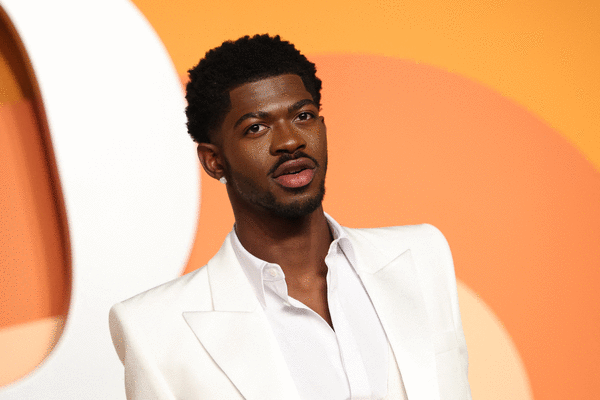
For strict institutional gatekeepers, Billboard has been quite lax about allowing fake artists on its charts. By November, several AI performers were featured, including country music’s Breaking Rust and R&B’s Xania Monet.
It’s the kind of casual absurdity that AI music startups like Suno are hoping will become, well, casual. “The technology finally allows for billions of people to be creative, to have the fruits of their labor, to feel fulfillment in a different way,” Suno co-founder Mikey Shulman told Forbes in April.
But the inclusion of those fruits — AI creations — on the music charts is an existential emergency signal, raising logistical questions for the music industry. The good news? Answering them correctly should be straightforward for Billboard.
The company has spent the last 113 years meticulously defining its hallowed charts, finding reasons to keep actual human beings off them. Now, for the sake of artistic innovation and good-natured competition, Billboard needs to use that same discernment to keep AI out.
A lot of the earlier exclusions came down to technical designations. By the time Billboard decided to factor video streams into the Billboard 200 in 2020, rapper YoungBoy Never Broke Again’s YouTube presence had already rendered the measurement a moot point. His YouTube dominance had outpaced his success on the albums chart by so much that it became a sociology lesson. On the charts, he was an emerging star. On YouTube, he was already one of the biggest. That schism was the result of an institution refusing to update a system audiences had outgrown.
That classification gap distorts and defines ideas of mainstream stardom, and even genre. In the spring of 2019, rapper-singer Lil Nas X had the biggest country song in America. Until he didn’t. After “Old Town Road” charted on the Billboard Hot 100, Hot Country Songs and Hot R&B/Hip-Hop Songs charts at the same time that March, Billboard unceremoniously removed the single from the Hot Country Songs chart.
The company’s decision-makers defended the move by explaining that “upon further review,” the song supposedly did not include “enough elements of today’s country music.” Seven years later, the track, a country single laced with 808 drums (1), doesn’t sound all that different from the ones country superstar Morgan Wallen releases all the time. The Lil Nas X track had a harder time gaining entry to Billboard’s country listing than Breaking Rust. Yet unlike the latter, which only lives in an anonymous Silicon Valley computer server, Lil Nas X actually exists.
But Billboard’s classification logistics go beyond identity politics. As major labels have devised ways to juice album sales, Billboard has developed ways to make them unsuccessful. When Travis Scott’s "Astroworld" held off Nicki Minaj's "Queen" for a second straight week at No. 1 in 2018, Minaj called out Scott and Billboard for using a special merch bundle to inflate his sales total and keep him at the top of the Billboard 200. Minaj’s outcry didn’t help her, but by October 2020, the company had banned bundle packaging as part of its sales calculations.
It was a way to combat an epidemic of fake sales. Now Billboard is facing off against fake artists. Or rather, it should be.
Beyond what is and isn’t an album sale and what a genre can or cannot be is the matter of institutional intention. When the Billboard charts were created over a century ago, they were designed to be a record of the times: “here’s what people are listening to.” The rankings are also a competition between human beings — and the limits they naturally possess. Seen that way, landing a coveted spot on the charts resembles a sport.
We don’t applaud cheating in that realm, do we? Lance Armstrong got banned for using performance-enhancing drugs. Imagine if he had a robot cyclist to complete the Tour de France in his stead? If Billboard continues allowing AI music creations in its charts, human beings will be competing against machines instead of just each other.
Sure, people use tools. But singers who use Auto-Tune, for example, are still singing. Even when an artist uses a songwriter, they’re still performing — not to mention, the songwriter is also human. Those elements exist to amplify talents that (usually) are already there. AI music exists to generate abilities that aren’t naturally there.
If the Billboard charts are to remain a competition — and a series of course corrections — the company will have to confront AI music head-on. One solution is perhaps creating a separate chart for AI creations. But if Billboard has any misgivings about excluding AI entirely from its other storied rankings, it shouldn’t. After all, it’s said “no” before.
____
(1) 808 drums are powerful synthetic bass drums used prominently in hip-hop, R&B, and other genres.
____
This column reflects the personal views of the author and does not necessarily reflect the opinion of the editorial board or Bloomberg LP and its owners.
Peter A. Berry is a culture journalist with bylines in XXL, Variety, COMPLEX, Rolling Stone, Okayplayer and more. He also writes the "Rate It Or Love It" newsletter on Substack.
©2026 Bloomberg L.P. Visit bloomberg.com/opinion. Distributed by Tribune Content Agency, LLC.








Comments