Rush reunion becomes a moving tribute to Neil Peart and Anika Nilles' coronation at Kia Forum
Published in Entertainment News
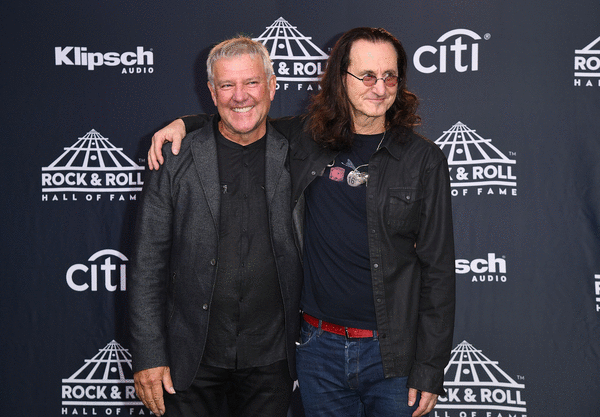
LOS ANGELES – It was a celebration, a time machine and a delirious three-hour workout of air-drumming. Storming the Forum in Inglewood on Sunday, Canadian prog-rockers Rush played their first official concert since 2015, when the band ended what seemed to be its final tour, even if they couldn't bring themselves to say so. During its more somber moments Sunday, the show also felt like a tribute to Neil Peart, the group's revered scholar of a drummer who died of brain cancer in 2020, a loss that made such an evening unthinkable.
But maybe most of all, it was a coronation of sorts — for 43-year-old German percussionist Anika Nilles, sitting on Peart's throne. How did she wear the crown? Confidently. She nailed complex paradiddles and splashed nearly a dozen cymbals with abandon. Rarely did her expression stray from a furrowed brow. (To be fair, Peart's never did either.) This is the most fearsome repertoire in all of pop music, and Nilles supplied its heartbeat and muscle, and most of its nuance. I sincerely hope she's having fun.
The devout crowd — is there any other kind of Rush fan? — certainly was. A dad-heavy audience accompanied by teens here and there (hopefully a few future Anikas), these longtime listeners were vocally transported throughout. That began with the shocked roar that met Rush's first number, 1977's "Xanadu," a chugging slab of custom-van-tested shag splendor, akin to kicking off a trick show with the most dangerous stunt.
"I'm going to start playing a song now," guitarist Alex Lifeson said after a little banter, a mumble that became the ultimate flex when the song turned out to be "Limelight," the strutting riff that launched a million amp-jacked hopefuls. Only 10 minutes in and Rush could go anywhere, into nearly 50 years of material.
Wisely, that path included five selections from "Moving Pictures," the group's totemic 1981 release, its most sinewy and muscular, including the ominous "Tom Sawyer," a virtuosic "YYZ" and a spin through the car chase "Red Barchetta." Bassist and singer Geddy Lee, his voice eerily well-preserved for a 72-year-old, rode the contours of these numbers with electrifying menace and character, justifying all the risks inherent in this reunion tour. (An additional 87 dates will follow globally.)
There was also vindication for some of Lifeson's more adventurous guitar work of the early '80s, when he all but invented a new chime-laden language of soloing. A punk-vicious "Subdivisions" — "Be cool or be cast out," go the lyrics — benefited from added grit, while 1984's "Distant Early Warning" burrowed into nuclear anxiety with unstoppable momentum.
The band, expanded to include touring keyboardist Loren Gold, seemed exhilarated, if a little stiff at times, a first-night quibble that will surely self-correct. Some of the dead-on precision of Nilles' attack was lost by out-of-sync video screens, an annoying glitch that needs attention given her monster performance. She has learned how to play the intimidating "La Villa Strangiato" perfectly — it's the least they can do.
Angelenos enjoyed a special unannounced guest, Aimee Mann, who re-created her ethereal backup vocals on 1987's "Time Stand Still," Rush's finest balance of song craft and chops. (The song's title could have been the motto for the night.) Pecking Lee on the cheek, Mann relished the big-arena rock moment.
Delightfully, there remains something strange yet approachable about Rush. True fans know this for the compliment it is. It's not just their goony sense of humor that compels them to make silly intro videos and do funny accents. (The new one takes place in a haunted house and, yes, there are cameos from the "I Love You, Man" guys Paul Rudd and Jason Segel.) Nor is it the way they never concerned themselves with prowling the stage or donning anything other than sensible blazers and jeans.
No, the truly strange thing — still remarkable to experience among thousands — is the way their fame is grounded in epic rafts of sci-fi nerdiness. Peart, also the band's lyricist, steered them through phases of paperback fantasy, stubborn Randian Objectivism and a lived-in sense of wisdom showcased on their final studio album, 2012's "Clockwork Angels," and its lovely closer "The Garden," also revived tonight.
Yet this was a set that included the cavorting "By-Tor and the Snow Dog," the mathy "Natural Science" and the sidelong 1976 stoner perennial "2112," which, even in its abbreviated form, conveyed the pungent sense of a band going its own way. When the intermission's countdown clock reversed itself, climbing back up to "21:12," the numbers turned red and the crowd exploded.
I would have liked to see Nilles take a bow, flanked by Lee and Lifeson. She's the reason why any of this is happening. Maybe after a bit, she can drop the deference. Rush may be onto one of its most significant chapters, the one that extends beyond them, in which their music will bond generations and even transcend death. This tour is doing the good work.
--------
©2026 Los Angeles Times. Visit at latimes.com. Distributed by Tribune Content Agency, LLC.








Comments