Bipartisan bill would study maternal health-violence link
Published in Health & Fitness
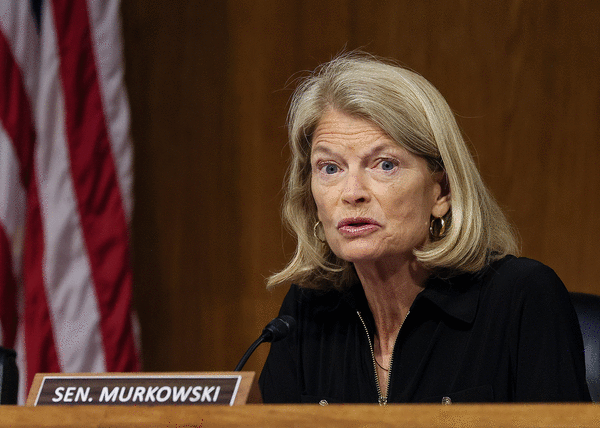
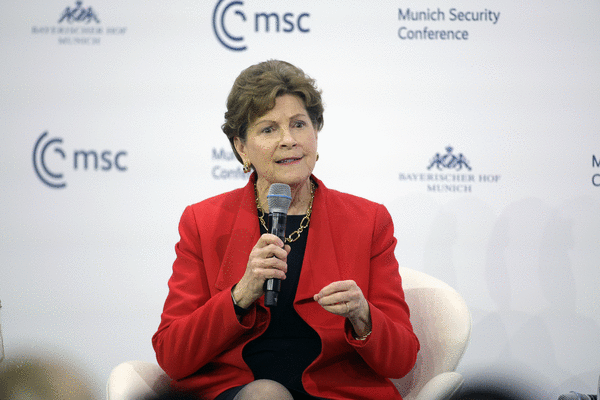


A bipartisan pair of senators on Monday introduced legislation that would support research into the link between intimate partner violence and maternal deaths and illness.
The legislation by Sens. Jeanne Shaheen, D-N.H., and Lisa Murkowski, R-Alaska, would direct the Health and Human Services Department to support research on how domestic violence, sexual assault, stalking, human trafficking, child sexual abuse, forced marriage and other forms of abuse impact the risk for death or serious complications during pregnancy and the postpartum period.
Shaheen introduced a similar bill in 2021, but this will be the first time the legislation will have a Republican co-sponsor in the Senate. It arrives at a time when spending on research into women’s health issues at the federal level is being curtailed, advocates say.
“It’s unacceptable that research linking maternal and child health outcomes to the physical and mental trauma of intimate partner violence is still lacking despite the alarming prevalence of sexual assault among pregnant women and the danger posed to mom and baby alike,” Shaheen said in a statement.
A House version is planned by Rep. Gwen Moore, D-Wis.
The research would examine how these issues increase the risk of suicide, homicide, substance abuse, drug overdose or poor health outcomes in pregnant and postpartum women.
The bill would also direct the study to give a “particular focus” to impacts on diverse communities, including people of color, adolescent mothers and people of different sexual orientations and gender identities. HHS would enter an arrangement with the National Academy of Medicine or another “appropriate entity” to support the research.
Drug overdose, suicide
Data from the Centers for Disease Control and Prevention show maternal deaths surged during the COVID-19 pandemic but have since returned to pre-pandemic levels. That data also shows Black women face much higher rates of maternal mortality, totaling 44.8 per 100,000 live births in 2024 compared to 14.2 for white mothers.
But the figures only account for medical causes of maternal mortality, including cardiovascular conditions, infections or hemorrhages.
Researchers who have looked at all deaths among pregnant and postpartum women find drug overdose and violence, including suicide, were the top two causes of death between 2018 and 2023, according to research published in the New England Journal of Medicine.
In the six-year period, researchers found 7,901 deaths among people who were pregnant or who had given birth in the previous 42 days.
The CDC separately found the homicide rate for women between the ages of 15 and 44 is 16% higher among those who were pregnant or within one year of pregnancy.
Still, those numbers don’t include thousands more women who don’t die but experience poor health outcomes. The CDC separately estimates 6% of people experience emotional, physical or sexual violence by an intimate partner.
“In the past few years, there has been a lot more traction on the impact of maternal mortality and morbidity but we need more research on how this intersects with intimate partner violence,” said Tiffany Garner, policy advocate at Futures Without Violence, an organization working to end violence against women and children.
The bill would also direct HHS and other agencies to award grants to entities that use innovative approaches to improve maternal and child health outcomes for victims.
It would authorize $15 million in spending annually for three fiscal years.
Cutting back
The legislation comes as President Donald Trump’s administration is sidelining research into women’s health issues.
In 2025, the National Institutes of Health — the primary federal funder of health research — funded 31% fewer grants that included the word “women,” according to a Washington Post analysis.
The National Academies of Sciences, Engineering and Medicine, an independent organization named as a potential research partner in the Shaheen-Murkowski bill, has had to lay off staff because hundreds of contracts awarded by the government were canceled.
The administration has defended its cancellations as a “realigning” of research with administrative priorities, stating it will no longer fund studies related to diversity, equity and inclusion.
HHS Secretary Robert F. Kennedy Jr. defended those cuts over the past week on Capitol Hill, especially as they relate to maternal health research, including studies focused on deaths of Black women.
Rep. Summer Lee, D-Pa., questioned Kennedy at an Education and Workforce Committee hearing last week about what the administration is specifically doing to further research into Black maternal health.
“How could we solve the Black maternal mortality crisis if we can’t say Black?” she asked.
“President Trump is trying to end division in this country, not sow division,” Kennedy replied, adding that the department’s work on maternal health more broadly “helps everybody.”
The Trump administration also has slowed the dispersing of grants under the Department of Justice Office on Violence Against Women. Those grants go to organizations working to address domestic violence, dating violence, sexual assault and stalking in their communities.
Millions of dollars for those programs have gone unspent, according to news organization The 19th, which specializes in reporting on gender and politics.
©2026 CQ-Roll Call, Inc., All Rights Reserved. Visit cqrollcall.com. Distributed by Tribune Content Agency, LLC.









Comments