From piping plovers to dragonflies, federal changes could threaten endangered Midwest wildlife
Published in Science & Technology News
CHICAGO — As temperatures hovered around 80 degrees and few clouds obscured a bright blue sky, many people took the opportunity to enjoy a summer day last week at Montrose Beach. Children dug holes in the sand. Families kicked around soccer balls. And some cautiously waded into water against crashing waves.
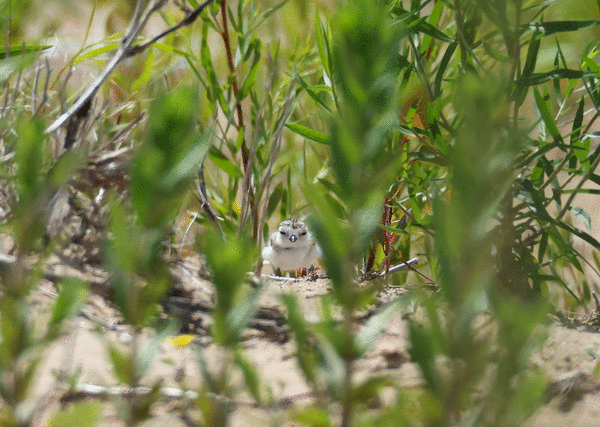
At a nearby stone pier, people participated in a different type of entertainment: bird-watching. Present in the area were the American herring gull, mallards and sanderlings. But enthusiasts walking to the edge of a fenced-off sanctuary kept asking each other the same question: Had anyone seen a piping plover?
The tiny, sand-colored shorebirds — as well as North America’s tallest bird and an unusual dragonfly — are among many animals in the Midwest that may be affected by recent changes weakening the Endangered Species Act, the primary law outlining conservation of at-risk wildlife in the U.S.
Alongside other alterations, the administration of President Donald Trump changed the definition of “harm” to no longer include significant modification of endangered species’ habitats. Experts and advocates say this change will put these species at risk of extinction.
“If you take water away from a fish, you’re going to harm that fish,” said Ben Greuel, national wildlife campaign manager at the Sierra Club. “You’re taking away the habitat it needs to survive. That was a common sense element of the Endangered Species Act.”
Even less protection
Greuel identified the piping plover as one animal at significant risk due to the change in how harm is defined, saying the birds are an Endangered Species Act “success story.”
The Great Lakes’ piping plover population reached an all-time low of about 13 pairs in the 1980s after habitat loss due to beach development, according to Chicago Piping Plovers, which tracks the birds. Numbers rebounded to around 80 last year after significant conservation efforts.
Tamima Itani, leader of Chicago Piping Plovers, said the Chicago Park District has been an excellent partner in providing sanctuary for the birds. What’s concerning to her about the federal changes, she said, is what will happen when piping plovers fly south for the winter.
“That’s what I worry about; will those beaches be protected and preserved for these birds to return to?” Itani said.
The Endangered Species Act always allowed developers to modify habitats, said Kristen Boyles, managing attorney at Earthjustice. The legal nonprofit focuses on environmental issues.
But for state, local and private projects, Boyles said developers have been required to create “habitat conservation plans” to receive construction permits. She called these plans “ironic,” as they detail how endangered species’ habitats will be destroyed but in lesser amounts than they would have been otherwise.
“That permit then says, ‘Go ahead. Whatever you’re going to do now, even if it destroys and degrades some habitat, it’s lawful because you’ve come up with measures for mitigation, or you’re doing things less harmfully than you initially would,’” Boyles said.
While the Endangered Species Act has shortcomings, once these changes go into effect next month, even fewer protections will exist, Boyles said. Developers will no longer need to submit a habitat conservation plan, she said.
Conservations groups, represented by Earthjustice, sued the Trump administration last month to restore the prior definition of harm.
According to the U.S. Department of the Interior’s website, the reclassification was based on a U.S. Supreme Court case from 2024 requiring agencies “to follow the single best meaning of a statute rather than contorting laws to fit political agendas.”
Boyles said this interpretation is incorrect. The case they cite actually gives the role of interpreting regulations to courts instead of agencies, she said.
Boyles said it’s still unknown exactly what will happen when the changes go into effect. Agencies will likely begin to approach the permitting process from the perspective that harm no longer constitutes modifying an endangered species’ habitat, she said.
“Based on the statute itself, I would hope that very little would change,” Boyles said. “But I think I would hope in vain.”
After the harm reclassification, the Trump administration announced two additional changes to the Endangered Species Act, according to a July 17 statement. First was the removal of protections automatically granted to threatened species, treating them similarly to endangered species.
Second, the term “critical habitat” must consider “economic, national security and other relevant impacts.” An area can now also avoid the critical habitat label if its exclusion will not cause the extinction of a species.
Whooping crane rebound
Earlier this year, Greuel said he took his children to the Horicon National Wildlife Refuge in Wisconsin. They were among many observing whooping cranes: North America’s tallest birds. Some of them breed in Wisconsin, and males can stand about five feet tall, according to the U.S. Fish and Wildlife Service.
“It’s a great way to teach our kids about the success of the Endangered Species Act and the importance of protecting the habitat for animals that need it,” Greuel said.
Whooping cranes are another Midwestern animal at risk due to Endangered Species Act changes.
Rich Beilfuss, president and CEO of the International Crane Foundation, said the law has been especially useful when trying to prevent the building of power lines where whooping cranes may collide with them.
“The Endangered Species Act is a tool in the toolbox for that, but it can be a very important one when you’re up against a big project that really is harmful but has enormous development pressure,” Beilfuss said.
Three years before President Richard Nixon signed the law in 1973, the whooping crane was listed as endangered under the act’s predecessor, according to the U.S. Fish and Wildlife Service’s website. Tens of thousands of these birds used to live in North America but, following habitat loss, the population dropped to just 15 in 1938. There are estimated to be more than 500 whooping cranes today after decades of wetland preservation under the Endangered Species Act.
In the U.S. Department of the Interior’s July 17 statement, Secretary Doug Burgum said the law has driven up costs for families, weakened the country’s competitiveness and undermined national security.
But Beilfuss said the law was more about maintaining a delicate balancing act between human and environmental interests.
“The Endangered Species Act was never about putting the well-being of species over the well-being of people,” he said. “It’s really about trying to create a voice for trying to do development better, more sustainably, keeping development out of areas that will really have a significant impact on species we care about.”
“I fear this will slant us too far toward not having any voice in those kinds of decisions,” Beilfuss said.
Dragonfly challenges
Species living in specialized environments are particularly vulnerable to habitat destruction, said Marla Garrison, faculty emeritus at McHenry County College. One example is the Hine’s emerald dragonfly, the only dragonfly on the federal endangered species list. Research suggests these insects, found in northeastern Illinois and other Midwestern states, require burrows created by Great Plains mudbugs and water flowing over the mineral dolomite, Garrison said.
Garrison said killing individual insects for educational purposes isn’t really a concern. Every child should have a bug collection, she said. The most significant impacts to insect populations come from human disturbances to habitats.
“Hine’s emerald is a perfect example of how it is dependent on critical habitat, not on individual hunting or loss,” Garrison said.
Andres Ortega, aquatic resources supervisor at the Forest Preserve District of DuPage County, said the most robust population of Hine’s emerald dragonflies is in Door County, Wisconsin, at roughly 3,000 adults per year. Ortega said this is a relatively low, but stable, number for an insect.
Throughout all of Illinois, he said there are an estimated 200 to 300 adults yearly.
“For an insect, that is considered being on the brink of extirpation or local extinction from Illinois,” Ortega said.
To illustrate how easily insect habitats can be harmed, Garrison gave the example of water trickling down a hill into a wetland. If a housing development went up, it could cut off the source of water and destroy the habitat. Sometimes developers pledge to restore these habitats, but it’s not possible to fully re-create what was already there, Garrison said.
“You can’t rebuild something that took tens of thousands of years to form through glacial deposits,” she said.
Ortega also said fully recreating natural conditions for the dragonflies would be very difficult if not impossible. However, the Forest Preserve has gotten “very close” by modifying areas with characteristics already conducive to the species, he said.
“Down the road, there may be other areas identified that have similar characteristics that, with some man-made modifications and restoration work, could become, or become again, Hine’s emerald habitats,” Ortega said.
Garrison said insects, sometimes seen as just “biting and stinging things,” are often overlooked in discussions about conservation. They can also be less visible than the animals people look for at Montrose Beach.
Everyone else
Alex Terrana, 42, stood on the stone pier watching birds through a pair of black binoculars. She was looking for willets, but, upon hearing a piping plover was spotted earlier that morning, said she’d have to check it out.
Terrana said she logs birds at River Park for a local nonprofit once a week, and she thinks fondly of the peregrine falcons that sometimes nest on her Edgewater high-rise.
“I find it helps me to appreciate the city in an additional way,” Terrana said. “In the city there’s sirens and alarms, and here it’s like, ‘Oh, here’s a bird.’”
Like Itani, Terrana said the city of Chicago does a great job supporting the piping plovers. The Park District expanded the birds’ habitat at the Montrose Dunes in 2021 after Monty and Rose, the first piping plovers confirmed to nest in Chicago in over half a century, unified city residents around their success raising chicks.
However, local involvement only matters so much when regulations like the Endangered Species Act keep getting changed at a federal level, Terrana said.
“Over time, what everyone else is doing is going to affect us, even if we are protecting Chicago,” Terrana said.
_____
©2026 Chicago Tribune. Visit chicagotribune.com. Distributed by Tribune Content Agency, LLC.





Comments