After Gov. Gavin Newsom veto, California Environmental Quality Act fight moves from the Capitol to the ballot box
Published in Science & Technology News
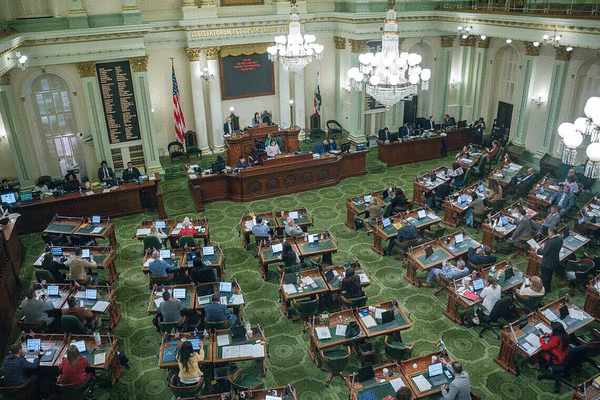
SACRAMENTO, Calif. — Gov. Gavin Newsom vetoed a bill last week to narrow an exemption to the California Environmental Quality Act for manufacturing facilities. But the long-running political struggle over the cornerstone law continues apace, with both sides now turning their full attention from the Capitol to the voters.
That’s because one of the 14 measures on this year’s ballot would speed up approval under the act for eight categories of building projects — housing and public health developments (such as hospitals); a wide range of clean energy projects; water infrastructure; schools including higher education facilities; public safety projects, including wildfire mitigation work like vegetation management; transportation; and broadband and digital access.
After Newsom’s veto of Senate Bill 954 — an attempt by concerned lawmakers to claw back environmental protections they said the Legislature gave away the year before — the ballot measure is now the primary front in a debate increasingly pitting CEQA’s defenders against both industry representatives and also more moderate Democrat politicians.
The long-simmering debate over CEQA “has become particularly acute and intense” said the bill’s author and Senate Environmental Quality Committee Chair Sen. Catherine Blakespear, D-Encinitas. Blakespear traced the growing fervor over environmental regulations to the 2025 publication of the book “Abundance,” written by Derek Thompson and Ezra Klein, who has long been considered a deep policy thinker by many moderate Democrats.
Newsom embraced the ideas in that book, as did other California Democrats. Now, Proposition 45 will put questions it raised to voters, testing whether they’re worried enough about California’s economy to change its bedrock environmental policy, at least for some projects. Measure opponents say environmental laws are being blamed for costs of living increases driven by broader economic forces.
“What’s happening is this bigger clash between a desire for the abundance movement to be successful, which is basically the understanding that we need to be delivering the things that people need for our society; housing and internet and transportation and clean energy,” Blakespear said last week, when she joined other lawmakers to speak against Prop. 45. “And then an effort to [scapegoat] environmental laws when the delays and the costs are not typically actually related to the environmental laws. It’s a whole range of reasons that things get delayed, and it’s easier to blame CEQA.”
But proponents point to what they say is mounting evidence of CEQA’s role in slowing the state’s growth, particularly in housing construction. Last week, the Yes on Prop 45 campaign highlighted a study published by the corporate law and lobbying firm Holland & Knight. The study examined 11 years of CEQA lawsuits and concluded that nearly two-thirds of them aimed to slow or block infill development with California towns and cities — where many state policymakers want to see more affordable housing built.
“California cannot solve its housing, infrastructure and affordability challenges if CEQA continues to delay the very projects the state urgently needs,” said the study’s lead author, Holland & Knight attorney Jennifer Hernandez, in a news release from the campaign.
Its backers and architects say Prop. 45 will streamline CEQA review for covered projects by imposing deadlines on agencies and courts to issue approvals or disapprovals. The proposition would put a 365 business-day clock on government agencies to approve or reject a project’s environmental impact report. And on the courts, it would impose a 270-day deadline to resolve any legal challenges brought by project opponents.
Tensions over CEQA have built for years as Californians grapple with housing scarcity, though experts disagree on its exact scale, and delays and cost overruns to infrastructure projects that the law’s critics say drive up the high cost of living.
In the Capitol, that tension drove legislation in 2025 to create a series of exemptions for housing and infrastructure development. Newsom put his foot down in that fight, refusing to sign the state budget unless lawmakers passed the exemptions. Blakespear and a large contingent of lawmakers had sought through SB 954 to narrow those exemptions for advanced manufacturing facilities. Seventy-eight Democrats in the Assembly and Senate backed the bill, while a handful of members of the supermajority party withheld their votes and Republicans voted en masse against it.
Opponents, which included a consortium of industrial and business interests including the Bay Area Council, an influential business advocacy group, accused Blakespear of seeking to repeal the exemption before it had a chance to spur development.
Newsom sided with those groups, writing in his veto message that the senator’s bill would have slowed “a long-overdue overhaul to get California building again.”
But Blakespear and her allies didn’t take long to bemoan the bill’s demise. A few days later, she and other lawmakers were speaking against Prop. 45, as a coalition of environmental groups and labor organizations ramps up the campaign against the measure.
The lawmakers said the measure, which runs 41 pages and would apply to eight fairly broad categories of building projects deemed essential, is CEQA’s opponents seeking to take a cudgel to an act that should at best be tweaked carefully in Sacramento. Blakespear pointed to four recent bills she said lawmakers passed to ease the approval of housing.
“We are actually working in the Legislature to promote what we want, and this just goes way too far,” she said.
But some lawmakers do support the measure. Perhaps most notable was an endorsement in February from Assembly Appropriations Chair Buffy Wicks, D-Oakland. The lawmaker has been a driver of bills to spur housing construction, and at one point in the legislative session, SB 954’s backers worried she’d use her powerful committee chairmanship to kill the bill. Wicks ultimately voted in favor of the bill after policy implications to housing construction were amended out.
“We have to build for the modern era, and I think we can do so in a way that still respects our environmental values,” Wicks said when backing Prop 45.
So far, the public polling on the measure’s popularity with voters hasn’t been definitive. In late June and early July, 73% of likely voters told pollsters for the Public Policy Institute of California they’d vote yes on a proposal to expedite CEQA reviews for housing, transportation, health, water and clean energy projects. But, those polling numbers changed earlier this month when PPIC again asked voters about the measure, this time using language closer to what will be on the ballot in November.
In that poll, only a slim majority, 49%, of likely voters said they’d vote yes, while 46% said no and 5% said they were undecided.
“It is clear that once voters learn exactly what this measure does — allowing developers to fast-track polluting projects like data centers in communities across California, lowering our state’s defenses to Trump’s attack on clean air and water and then sticking us with the bill — the more they sour on it,” said the No on Prop 45 campaign in a statement highlighting the sharply lower support.
The measures proponents have accused the No campaign of trying to scare voters away from what they describe as a limited set of rule changes designed to ease approvals for only projects in the public interest.
“The opponents have been shamelessly dishonest in stoking fears over the ballot measure’s impact on California’s natural resources and the health of our communities. They want to distract voters from the fact that Prop. 45 is a change in government process, not environmental protection,” said California Chamber of Commerce President Jennifer Barrera in a blog post.
The two sides have clashed vehemently over whether the measure would apply to data centers, which are extremely politically unpopular projects.
____
©2026 The Sacramento Bee. Visit at sacbee.com. Distributed by Tribune Content Agency, LLC.






Comments