Cuba wins UN debate on US sanctions but faces eroding support from key countries
Published in Political News
Cuba succeeded Tuesday in a push to debate U.S. sanctions at the United Nations at a time of unprecedented pressure from the Trump administration on the communist regime in Havana.
But the high-stakes maneuver also revealed how the Trump administration has succeeded in eroding the diplomatic support Cuba once had on this issue from its Caribbean neighbors and key Latin American and European countries, who either voted against, abstained or stayed away from the session altogether to avoid straining their relationship with the U.S.
Cuba’s foreign minister Bruno Rodríguez used the debate to accuse the United States of committing “genocide” against the Cuban population. To the U.S. embargo, he says, the Trump administration added “an energy siege, which is equivalent to a naval blockade, which is an act of war.” He demanded “the clearest statement” from the United Nations condemning these actions.
The U.S. representatives, who objected to the debate, called it a “whitewashing” exercise that would give Cuba an opportunity to spread propaganda and place blame for the country’s long-unfolding humanitarian crisis squarely on the United States.
“Havana calls this meeting, year after year — and now twice in one session — because it wants to make this Assembly complicit in its machinery of repression,” said Amb. Jeffrey Bartos, U.S. representative for U.N. management and reform. “It wants the U.N. to buy it another propaganda clip. It wants to use your voices and your silence to show the world … it can enrich itself, starve its people, send dissidents to prison, exploit slave labor around the world, play the victim and still get applause here in New York.”
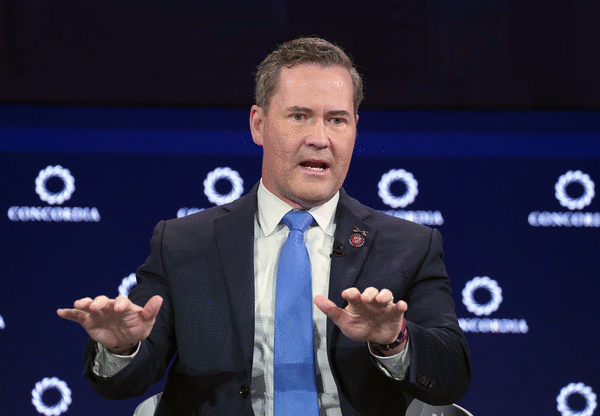
The U.S. ambassador to the United Nations, Mike Waltz, downplayed the effects of the U.S. embargo on the Cuban population, stressing it includes several exceptions for trade and humanitarian aid to the island. While the country had no electricity due to the grid’s collapse, there was enough fuel, he said, to power the government’s offices and Castro’s family compounds. And he questioned what Cuba’s secretive military conglomerate GAESA has done with the $18 billion in assets the Miami Herald reported it had in 2024.
“The world should not help the Cuban regime hide its incompetence, and its malice, and its corruption, and its greed,” he said.
Caribbean countries pitch mediation
Fighting U.S. sanctions is Cuba’s number one diplomatic priority, and the government spends much time and resources working on the issue at the United Nations. That has led to the passing of a yearly resolution calling on the U.S. to end the embargo with very few votes against, usually only from the U.S. and Israel. That started to change last year, when the State Department began maneuvering diplomatically to gather support for the U.S. position, and 19 countries abstained or voted against the resolution.
Ahead of the vote, Cuba had deployed one of its top diplomats to Saint Lucia, where leaders from the 15-member Caribbean Community regional bloc known as CARICOM opened a four-day summit on Sunday. Cuba’s Deputy Foreign Minister Josefina Vidal met on Tuesday morning with several leaders, including the body’s secretary general, shortly before the vote. She declined to comment to the Miami Herald.
Despite efforts to secure full CARICOM support, the U.N. vote showed the community’s continued splintering on the Cuba issue even as leaders insist they remain in solidarity with the people of Cuba amid food shortages and rolling blackouts.
Grenada, one of Cuba’s closest allies in the region, and Trinidad and Tobago were among the nations at the U.N. that abstained, while Guyana and Antigua and Barbuda skipped the vote.
Trinidad and Tobago Prime Minister Kamla Persad-Bissessar said that while Cuba claims they have made 176 changes, she said referring to reforms announced last month, “they need to have free and fair elections. That’s what I would like to see. It’s the same stance I took in respect to Venezuela,” she said.
She noted that CARICOM leaders are all elected democratically and thus she cannot support a “handpicked dictatorial regime.”
“Our problem is the pain of the people. Humanitarian relief we will give,” she said. “But I cannot support a regime that is not voted by, that is not of the people, for the people.”
During the debate, CARICOM issued a terse statement read by Haiti’s U.N. ambassador, Pierre Éricq Pierre, expressing concern about the humanitarian crisis on the island and offering to mediate the conflict between two “friends,” the United States and Cuba. The statement did not mention U.S. sanctions, which the community has repeatedly opposed publicly.
As Vidal quietly made the rounds, normally vocal leaders were somewhat cagey, keeping comments focused on humanitarian support.
“We worry about the people there, the problems they have,” Suriname President Jennifer Geerlings-Simons said as she made her way to their first meeting of the day. “They are our brother nation, Caribbean and they are human beings and we don’t like when people suffer.”
In recent months, Caribbean nations have revisited their ties with Havana. Under pressure from the U.S., a number of countries have, for example, ended longstanding medical cooperation.
Guyana Foreign Minister Hugh Todd said Caribbean leaders had discussed Cuba’s humanitarian crisis during their summit and agreed to issue a statement. Although Guyana representatives did not meet with Vidal, Todd said he assumed her objective in attending the summit was the same as it has long been: pressing for an end to the U.S. embargo.
While Guyana still has “good diplomatic relations with Cuba,” Todd said the country has no desire to intervene in the conflict between Havana and Washington; it is for them to resolve among themselves. Their concern, however, remains for the people of Cuba.
“We’ve always been in solidarity with the people of Cuba. It’s a longstanding solidarity,” he said.
Jamaica Prime Minister Andrew Holness said leaders are all concerned about the humanitarian situation in Cuba. Jamaica voted in support of having the discussion at the U.N. on Tuesday.
“There is a crisis there and we need to pay close attention,” he said. “There is also a growing consideration for the need for reform in Cuba, we see some signs of that. We’ve seen where the Cuban administration has said they are taking on reforms so we continue to monitor that, we continue to offer our moral support to Cuba.”
The Dominican Republic, which is not a member of CARICOM but is a neighbor of Cuba and a close U.S. partner in the region, also skipped the U.N. vote.
Europe shifts position
Several other U.S. allies, among them Canada and Australia, and 15 European countries, including Germany, abstained, suggesting a change in EU policy towards Cuba. The European Union, which is an important source of humanitarian aid to Cuba, also issued a statement acknowledging the “adverse humanitarian impact” of U.S. sanctions on the Cuban people but added that the “dire situation is not due only to the embargo.”
The EU representative called on the Cuban government to enact “meaningful political and economic reforms” and release all political prisoners. He also urged the Cuban government to refrain from providing support to Russia’s aggression in Ukraine.
Ukraine, Czechia and North Macedonia voted against the debate as well as Argentina, Paraguay and Costa Rica. Bolivia and Ecuador abstained. In total, 136 nations voted in favor, 9 voted against and 30 abstained. The Cuban resolution passed with the support of several African and Asian countries, Cuba’s traditional allies like China and Russia as well as other sympathetic governments in Europe (Spain), Latin America (Colombia, Mexico), and the Caribbean.
The debate was full of theatrics from the Cuban delegation, which interrupted Waltz several times to call him a “liar” when he mentioned the July 11 protests in 2021 and to ask him to act with “decorum” when the U.S. ambassador questioned how the Castro family could afford 17 residences and a private island, or how Cuba’s president could afford luxury items like a Rolex watch or a Hermes tie.
“Five years ago this month, five years ago, on July 11, 2021, thousands of Cubans filled the streets and demanded freedom,” Waltz said when Rodriguez and Cuba’s ambassador to the U.N., Ernesto Soberón, started loudly pounding their desks.
“You can pound away, my friend,” Waltz continued. “This is not Havana. This is the United States of America. This is the United Nations. And we will speak, we will be heard and we will not be silenced like your own people.”
_____
©2026 Miami Herald. Visit miamiherald.com. Distributed by Tribune Content Agency, LLC.









Comments