Midterm voters split on abortion and trans healthcare ballot questions
Published in Political News
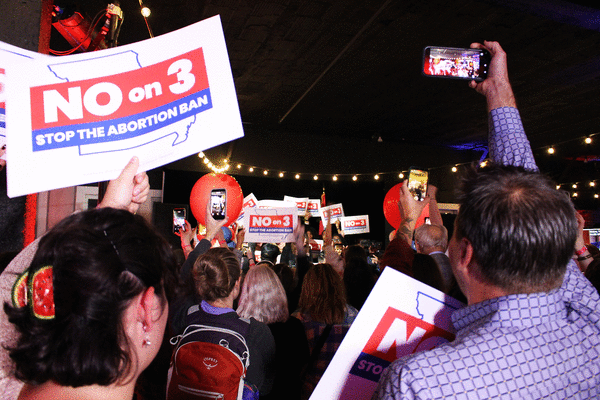



ST. LOUIS — Voters’ sweeping support of Democratic candidates in Tuesday’s midterm election didn’t translate into similarly clear outcomes for ballot initiatives on abortion access and transgender issues.
In Missouri, a state President Donald Trump carried by an 18-point margin in 2024, voters rejected a proposal to ban both abortion and gender-affirming healthcare for transgender minors.
Opponents of the measure celebrated the result with a mix of cheers, tears, hugs and dancing at an election night watch party in St. Louis — as many of the same people had done only two years earlier when Missouri voters enshrined abortion protections in the state constitution.
But in Washington state, which Trump lost by 18 percentage points in his most recent election, voters appeared to back a measure restricting trans kids’ participation in youth sports, with 60% of votes counted on Wednesday.
Voters also supported proposed restrictions on trans athletes in youth sports in Arizona and Nebraska. And as of Wednesday afternoon, similar restrictions as well as a ban on gender-affirming surgery for minors were leading in Colorado with about 80% of votes counted.
And while voters in Virginia and Nevada backed abortion protections, Idaho voters rejected them.
“Each state also has its own culture,” said Alina Salganicoff, director of Women’s Health Policy at KFF, a health information nonprofit that includes KFF Health News.
Missouri provides insight into voters’ motivations and thinking about the two separate but related issues. While political messaging in other states, including Virginia and Idaho, tied abortion and trans issues together, Missouri was the only state where the two were explicitly combined into a single ballot measure.
The measure that Missouri voters rejected Tuesday is part of a yearslong battle over abortion access in the state. Missouri was the first state to ban abortion after the U.S. Supreme Court overturned federal abortion protections with its 2022 decision in Dobbs v. Jackson Women’s Health Organization, leaving each state to make its own abortion policy.
In 2024, Missouri voters overturned the state ban by passing a ballot measure adding abortion protections to the state constitution. Opponents of that measure argued it would also allow a state ban on gender-affirming care for minors to be overturned. The abortion measure passed by fewer than 100,000 votes while Trump carried the state by over 550,000.
Two years later, the state’s Republican-dominated Legislature asked voters to reconsider, with this year’s measure to repeal the 2024 abortion protections.
The initiative also would have barred minors from gender-transition surgery, cross-sex hormone therapy, and puberty blockers. The legislature had already permanently blocked minors’ access to gender-affirming surgeries and temporarily blocked their access to new prescriptions for puberty blockers and cross-sex hormones until August 2027. The amendment would have enshrined those bans in the state constitution.
“Tonight is a loss for women, a loss for children, and a loss for life,” James Lawson, campaign manager for Her Health, Her Future, which supported the bans, said in an election night statement. He noted the campaign had built a coalition of doctors, pastors, parents, and volunteers and would continue its advocacy.
A survey of midterm voters by the NORC research organization, with questions from KFF, shows abortion was the stronger motivator of the two issues in Missouri, especially among those opposed to the proposed bans.
Of residents who voted against the measure, 59% said abortion policy was more important to their vote, while 33% said abortion and trans care for minors were equally important. The survey also found that 40% of voters opposed to the combined bans are supportive of restricting gender-affirming care while opposed to repealing abortion rights.
Of the voters who supported the bans, 26% said abortion was more important, 60% weighted the two equally, and 11% said trans care for minors was more important.
“This is the first time we saw these two issues linked,” KFF’s Salganicoff said. And while a sizable minority might be split on the two issues, “it’s not enough to move the needle on abortion rights when you have support in a state.”
Lindsey Dawson, director of LGBTQ Health Policy at KFF, said the Missouri survey data and broader election results across the country also appear to indicate that attempts to politicize trans care may not be as electorally significant as some had thought.
Outgoing Florida Gov. Ron DeSantis, a Republican, seemed to agree, telling reporters Wednesday, “I knew Republicans were in trouble when I was reading an overview about what were they running ads on, and they’re spending hundreds of millions of dollars across the country on transgender ads.”
That may have been effective four years ago, DeSantis said, but during this election, it “was kind of like an attempt to just scare Republicans to vote.”
At the St. Louis watch party for the coalition opposing the proposed Missouri bans, Shira Berkowitz of the LGBTQ+ advocacy organization PROMO Missouri credited the group’s canvassing campaign with helping to sway ambivalent Missouri voters.
The group’s effort included a team of trans Missourians who went door to door to share their personal stories, answer questions, and try to have “transformative” conversations.
“We proved so powerfully that our visibility is not a liability,” Berkowitz said. “We weren’t just running a campaign; we were writing a playbook. What we built here in Missouri, we built to last.”
_____
©2026 KFF Health News. Distributed by Tribune Content Agency, LLC.















































Comments