How energy costs, grocery prices and other everyday expenses have changed one year into the second Trump administration
Published in Business News


It’s been just over a year since President Donald Trump returned to the White House. In that time, he’s moved at a breakneck pace to enact his campaign promises, rolling back environmental regulations and protections, overturning national vaccine guidance and health policy, executing full-forced immigration raids in cities like Minneapolis and Chicago, and, more recently, undertaking a bid to control Greenland, a semiautonomous region of Denmark, a NATO ally.
But perhaps more than anywhere else, Trump’s return to office has been felt in the economic sector.
Through executive power and with a Republican-controlled Congress on his side, the second-term president has implemented far-reaching economic changes, from levying steep tariffs on U.S. trading partners to slashing funding for federal programs and Democratic-run states. In response, the stock market has careened and then recovered to historic heights, home sales hit a 30-year low, and the labor market remains sluggish.
Now January inflation data is here, and we’re getting a glimpse at how that economic policy is affecting Americans’ pocketbooks everywhere from the grocery store to the gas pump.
Across the board, consumer prices are 2.4% higher than they were a year ago, an increase driven largely by soaring food, electric and housing costs. On a monthly basis, the consumer price index rose 0.2%, down slightly from 0.3% in December, suggesting that inflation could be cooling. Gas prices are the lowest they’ve been in almost five years and eggs are back to pre-bird-flu averages, while ground beef and electricity are more expensive than ever.
Here’s an in-depth look at where things stand nationally — and locally — compared with 12 months ago.
The Tribune is tracking 11 everyday costs for Americans — eggs, milk, bread, bananas, oranges, tomatoes, chicken, ground beef, gasoline, electricity and natural gas — and how they are changing, or not, under the second Trump administration. This tracker is updated monthly using CPI data from the U.S. Bureau of Labor Statistics.
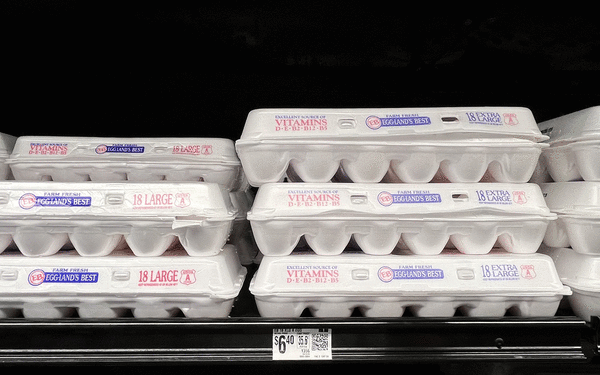
Eggs
Egg prices became somewhat of a hot-button issue in 2025.
Upon taking office, Trump inherited a growing crisis: bird flu. A strain of the disease known as highly pathogenic avian influenza had been spreading throughout the country in the final months of President Joe Biden’s term, but it wasn’t until winter 2025 when the number of cases peaked. Approximately 19.5 million table egg-layers were culled in January alone, according to U.S. Department of Agriculture data, significantly reducing the egg supply and leading to shortages in stores and record costs for consumers. In March, egg prices hit an all-time high of $6.23 per dozen.
But the Trump administration and Agriculture Secretary Brooke Rollins worked to tamp down bird flu and curb rising costs, notably with a $500 million investment to improve biosecurity on farms and another $100 million put toward vaccine research.
These measures, alongside a declining number of domestic cases as a result of migratory patterns, have helped egg prices steadily collapse since the springtime.
Currently, a dozen large Grade A eggs costs $2.58, marking a nearly two-year low. Moreover, prices are down almost 50% year-over-year — or a difference of $2.38 per dozen.
Milk
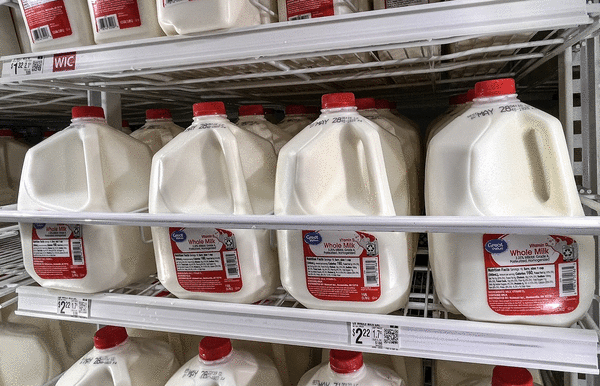
The cost of milk, meanwhile, jumped 5 cents from December. A gallon of fresh, fortified whole milk is now priced at $4.10 — a 2% increase from last year.
Throughout 2025, the price of milk hovered just above $4 per gallon. Costs spiked in the summer, with the single biggest jump from June to July, when the price went up 13 cents. Those summertime increases were likely a byproduct of lower milk production and stronger demand for dairy products, according to the USDA’s dairy market reports.
Bread
The cost of white bread also ticked up slightly in January.
Even so, at $1.84 per pound, the national average is roughly 4% less than it was when Trump started his second term.
Bananas
The fallout from the president’s trade war was perhaps most noticeable in the produce aisle. From avocados to blueberries and mangoes, many fruits and veggies saw measurable price increases.
Bananas in particular were hard hit by tariffs. The United States imports billions of pounds of the potassium-rich fruit every year, and tariffs imposed on top banana-producing countries such as Guatemala, Honduras, Ecuador, Costa Rica and Mexico ranged from 10% to 25%. Those raised import taxes were then passed on to American consumers, meaning inflated grocery store costs.
On multiple occasions, average banana prices surged to all-time highs and then surpassed those highs the following month. In September, the price peaked at $0.67 per pound — a 9% increase in cost from the last full month under Biden.
But in November, Trump took action to combat rising costs, announcing that some agricultural products would be exempt from reciprocal tariffs due to “current domestic demand for certain products” and “current domestic capacity to produce certain products.” Bananas were among the listed exemptions.
This year, the Republican president also hopes to finalize trade deals with three Latin American countries — Guatemala, Ecuador and El Salvador — to allow greater imports and further ease rising produce prices.
As of January, bananas were listed at $0.65 per pound, up 5% from this time last year.
Oranges
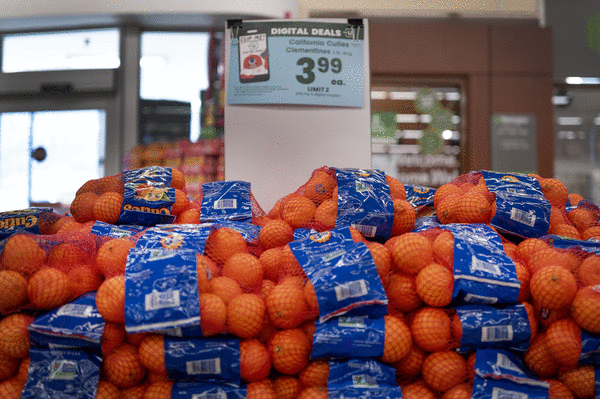
Orange prices, meanwhile, are down dramatically from the near-record highs observed in August and September. While a decrease in cost is standard for this time of year, the drastic drop could also be attributed to a combination of market factors and policy reversals.
Notably, domestic production was down in the 2024-25 growing season. California produced fewer navel oranges compared with the previous season, and Florida’s total orange production dropped by a whopping 32% to the lowest level in nearly a century. A lower domestic supply meant the U.S. was forced to import more of the fruit from foreign-growers, namely Mexico, Chile and South Africa. For much of the year, tariffs levied on these countries ranged from 10% to 30%, helping to push prices skyward.
But, as with bananas, reciprocal tariffs were removed for oranges in November, bringing down import costs and retail prices more broadly. The average cost per pound for navel oranges is now $1.54 — roughly the same as a year ago.
Tomatoes
The cost of field-grown tomatoes is also down, falling 5 cents since December to $1.79 per pound.
Prices are abnormally low given the tomato harvesting season. Typically, prices spike in the fall and peak in the early winter months, but according to the USDA, softer market conditions domestically have driven cheaper retail costs — particularly for this time of year.
In part because of this unseasonable drop, tomato prices are down almost 13% since Trump’s swearing in.
Chicken
Chicken prices remained fairly stagnant in 2025, not moving more than 7 cents in either direction.
While a surge in bird flu cases among breeder chickens pushed the national average to a new record in June, those increases were measured in a few cents. And prices dropped back around the $2 mark soon after thanks to a higher production of broilers — or chickens raised for meat — in the latter half of the year.
As of January, the cost of fresh, whole chicken was $2.04 per pound — 2 cents lower than it was when Biden left the White House. With the USDA projecting even higher broiler production this year, that average price could continue trending downward.
Ground beef
Unlike chicken, the cost of ground beef is skyrocketing.
Prices jumped another 17 cents month-over-month and are back at record highs. Since the change of administrations, ground beef costs have ballooned by 22% — an increase of $1.20 per pound for shoppers.
Elevated prices are the result of low domestic beef production. The U.S. cattle inventory is the lowest it’s been in 75 years, and severe drought in parts of the country has further reduced the feed supply and water access, per the National Agricultural Statistics Service’s January cattle report. This means the United States is importing more beef and cattle to meet demand, primarily from Australia, Brazil, Canada and Mexico.
But, as of November, imports of beef from these countries are no longer subject to reciprocal tariffs, and just this month, Trump signed a deal to quadruple the amount of beef imported from Argentina duty free.
Even so, beef prices will likely remain raised throughout 2026 given the time it takes to raise cattle for slaughter and for herds to repopulate.
As of January, a pound of 100% ground beef chuck would set you back about $6.69.
Electricity
Electric costs are also surging.
At just over 19 cents per kilowatt-hour, the current price of electricity is the highest on record, going back almost 50 years. With the average American household using roughly 899 kWh every four weeks, that translates to a monthly bill of about $173 before delivery charges, taxes and other fees.
Prices in Chicago are also on the rise. The Illinois Commerce Commission recently approved a $243 million rate reconciliation request for ComEd, the city’s primary electric utility. That hike will be passed along to customers this year via a delivery charge increase of $3.10 per month.
For Chicagoans and many across the country, relief is needed. Since this time last year, the average price of electricity per kilowatt-hour has increased by over 7%.
Gasoline
Some good news? The price at the pump has continued to fall, cresting below $3 per gallon for the first time since 2021.
A gallon of regular unleaded gasoline now costs $2.96, a 9-cent drop from the previous month. The cost of a fill-up is down in Chicago, too. From December to January, prices dropped another 14 cents per gallon, landing at $2.94, according to data from the U.S. Energy Information Administration.
Declining gas costs have become an oft-cited accomplishment from White House officials. In his most recent presidential address, Trump highlighted the work he’s done to lower prices, and last month, a Department of Energy press release cited falling gas prices as evidence of the administration delivering on its agenda of “American energy dominance.”
Since Trump took power a year ago, the cost of gasoline has fallen by almost 8% nationwide. During that same 12-month window under Biden, prices spiked by more than 46%.
Natural gas
Piped utility gas, or natural gas, is another expense that’s climbing.
Across the country, Americans are paying nearly 10% more to heat their homes, ovens and stovetops than when Biden left the Oval Office. Average prices nationwide sit at $1.70 per therm — the highest they’ve been in three years.
Currently, Chicago-area residents are paying a lower premium for gas. As of January, supply charges for both Peoples Gas, the city’s primary gas utility, and Nicor Gas, which serves customers in suburban Chicago, were priced at roughly $0.42 per therm, according to the Illinois Commerce Commission.
While that’s significantly lower than the national average, natural gas prices in the Chicago area are on the rise as well. In January, supply costs for Peoples Gas were up 25% from the previous year. For Nicor, that year-over-year change was even more drastic: a 50% hike.
What’s more, both Chicago-area gas utilities are seeking rate increases upward of $200 million this year. If approved, Chicagoans and suburbanites alike should expect higher monthly charges on their bills.
©2026 Chicago Tribune. Visit at chicagotribune.com. Distributed by Tribune Content Agency, LLC.









Comments