Larry Printz: Range Rover is betting the future of luxury isn't an SUV. It's a Grand Tourer
Published in Business News
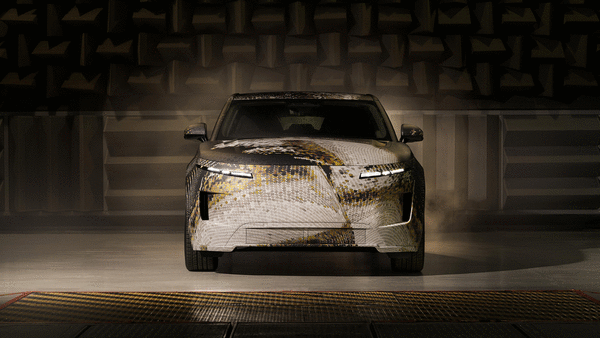
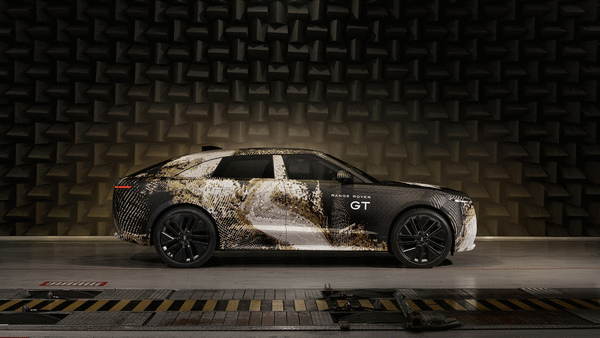



GAYDON, England — This week witnessed another luxury automobile unveiling. Yet this time, it seems to have wandered off script. Range Rover, the company that became fabulously wealthy convincing the world's affluent that every trip to the opera required eight inches of ground clearance and enough suspension travel to cross the Kalahari, has decided that the next frontier isn't another SUV. It's a grand tourer.
Or rather, something that insists on being both.
The new Range Rover GT arrives as the fifth member of the Range Rover family, and it occupies a category that didn't exist until the marketing department willed it into existence. Think Bentley Continental GT. Think Maserati GranTurismo. Now imagine one that sits high enough to let you survey traffic like a duke inspecting his tenants.
The conceit is delightfully cheeky.
For a century, the grand tourer has carried its own unwritten dress code. Long hood. Low roof. Driver practically reclining on the asphalt. A seating position requiring the flexibility of a circus acrobat and the optimism of someone who has never encountered a steep driveway. You know, like a Jaguar E-Type.
Range Rover has looked at all of that inherited wisdom and designed a GT with higher driving position. And somehow, according to Range Rover, it still drives like a GT. That proposition deserves admiration, skepticism, and preferably a winding road.
The GT is also the first all-electric Range Rover built on Jaguar Land Rover's new Electric Modular Architecture. It begins life as a battery-electric model, with a hybrid arriving later, assembled in Britain alongside conventional gasoline and hybrid vehicles. For an industry that alternates between proclaiming absolute certainty and changing direction every other Tuesday, keeping several bets on the table seems almost refreshingly practical.
But the real theater isn't under the floor, where the batteries reside. It's inside.
Modern luxury has become an exhausting contest to determine which manufacturer can install the largest screen, short of converting the windshield into an IMAX theater. Every new flagship arrives with numerous glowing rectangles framed in far too much shiny black plastic and faux carbon fiber trim.
Delightfully, Range Rover has set off in the opposite direction.
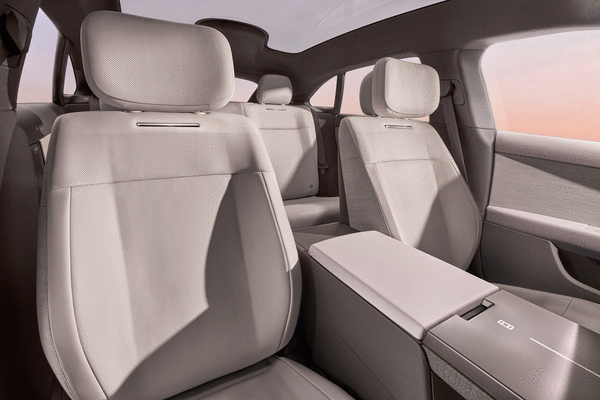
The instrument panel becomes architecture instead of furniture. Woven textile conceals the speakers. Air vents disappear into a single horizontal line. The instrument cluster shrinks to a slim display backed by a head-up display. Even the steering-wheel controls refuse to have its buttons appear until summoned. Technology hasn't vanished; it has simply stopped showing off. Range Rover calls it design reductionism.
The rear seat follows the same philosophy. Buyers may choose a either a bench or two executive chairs separated by a console containing wireless phone chargers, climate controls, cup holders and a refrigerator. Everything is integrated. Everything is orderly. Nothing appears desperate to impress.
Even the missing front trunk feels defiant. Elsewhere in the EV universe, every cubic inch of storage is celebrated like the discovery of a new continent. Range Rover shrugs. One cargo compartment has always been sufficient.
The deeper story, though, isn't about batteries or hidden speakers. It's about identity. For decades, luxury has been measured by more horsepower, more screens and more features requiring laminated instruction cards from the salesperson. The Range Rover GT argues for subtraction instead. Less visual noise. Less technological exhibitionism. Less visual noise.
And then comes the historical twist.
Grand touring was once Jaguar's native language. The XK-120. The E-Type. The XJS, XK and F-Type. Elegant machines built for crossing continents at indecent speeds: That was Jaguar's calling card. Meanwhile, Range Rover specialized in traversing landscapes where maps became optimistic suggestions.
Now, as Jaguar searches for its next identity, Range Rover quietly appropriates one of Britain's oldest automotive identities and translates it into an electric vehicle with enough ground clearance to ignore the occasional dirt road. Whether buyers embrace the idea remains an open question.
©2026 Tribune Content Agency, LLC










Comments