US, Iran trade drafts of deal as Israel expands Lebanon assault
Published in News & Features
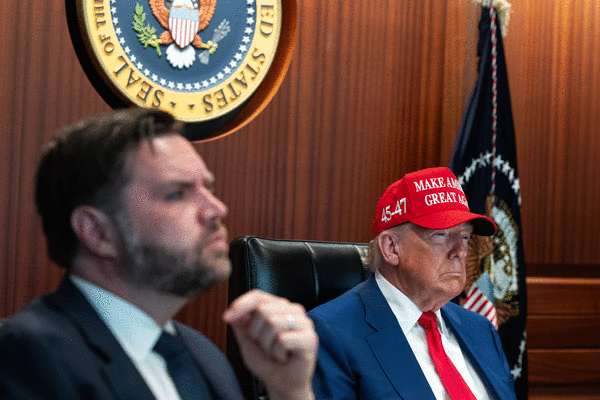
The U.S. and Iran traded messages over the weekend seeking changes to a draft agreement that would extend a ceasefire and open the Strait of Hormuz, but it was unclear if the sides were making much progress.
As the diplomatic exchanges continued, Israel expanded its ground assault in Lebanon, shattering a brittle truce with its northern neighbor.
President Donald Trump hasn’t spoken on the subject of Iran since a White House Situation Room meeting Friday in which he said he expected to announce an agreement. In a social media post earlier that day he reiterated his demands, including that Iran suspend its nuclear program and fully restore the strait to its earlier status as a free, international waterway.
The semi-official Tasnim news agency, which has close ties to the Iranian Revolutionary Guard Corps, said Sunday that amendments continue to be proposed by both sides, but noted that both the U.S. and Iran might ultimately reject the changes and the deal would collapse.
“Talks and message exchanges are ongoing, and until a definite result is reached, it is not possible to judge,” Iranian Foreign Minister Abbas Araghchi said, according to Tasnim. “Everything being said now is speculation and should not be given importance.”
Meanwhile, Israel made its broadest incursion into Lebanon in a quarter-century as Hezbollah — Iran’s most powerful regional ally — stepped up attacks on Israel’s north.
The Israeli military said Hezbollah fired more than 300 “projectiles” at its soldiers in Lebanon and at northern Israel over the weekend. The latest escalation has shattered a brittle ceasefire declared after the Tehran-backed group attacked Israel in response to its war on Iran, which it launched with the U.S. on Feb. 28.
Israel is not party to the talks between the U.S. and the Islamic Republic and it’s not clear whether it will agree to stop its side war in Lebanon if the war in Iran is resolved.
Talking points
On Saturday, Iranian state TV reported the existence of a new draft agreement, which it said gives the Islamic Republic “exclusive authority to determine the nature of transiting vessels” in the strait, a negotiating point the U.S. is unlikely to accept.
Trump once said Iran and the U.S. could manage its traffic in a joint venture. This week, the U.S. leader said that no one country would control the strait but that the U.S. would “watch over” it.
The draft also said the U.S. has committed to giving Iran access to $12 billion in frozen funds within 60 days, to be sent directly to Iranian banks without restrictions, according to Iranian TV, which added that the document was “unofficial” and not “finalized.”
The White House did not respond to a request for comment on the report.
Treasury Secretary Scott Bessent claimed that an Iranian commitment to refrain from seeking a nuclear weapon — a longtime key point of conflict — has been on the table in talks with the U.S.
“This is the first time the Iranians have ever been willing — in 47 years — to discuss not having a nuclear weapon,” Bessent said on Fox News’ "Sunday Morning Futures." “Now it’s on the table for the first time thanks to President Trump.”
Iran has repeatedly claimed since the 2015 nuclear deal made with the Obama administration that it was not pursuing a nuclear weapon. And in that deal, Iran agreed to cap uranium enrichment it said was for nuclear power and to ship its stockpile out of the country. When Trump rescinded that deal in his first term, Iran returned to enriching uranium beyond what the Obama deal allowed.
Markets have been whipsawed by the abrupt turns in rhetoric, but hopes of a ceasefire extension helped drive stocks toward a historic streak of weekly gains by week’s end, even as sporadic attacks occurred.
Trump’s former national security adviser, John Bolton, said Trump was willing to take an imperfect deal to ease Republicans’ growing worries about the congressional elections in the fall as voters are frustrated with rising energy prices.
“This is a deal about gasoline prices at the pump in the United States,” Bolton said on Bloomberg This Weekend. “Trump worries, obviously, about the price levels people are paying. He’s worried about the effect on inflation. He’s worried about the effect on the elections in November. But this is not a deal that really ends the war in a satisfactory way for the United States.”
Bolton warned that allowing Iran’s government to remain in power would enable it to rebuild its military and nuclear capabilities. “If the Iranian regime is allowed to survive, which it looks like Trump is prepared to acknowledge, they will simply benefit from the reopening of the strait to sell more oil, gain more revenue, and entrench themselves in power,” he said.
U.S. troops wounded
An Iranian ballistic missile strike on a Kuwaiti air base in recent days caused minor injuries to several Americans and seriously damaged two MQ-9 Reaper strike drones, according to a person with direct knowledge of the attack, who requested anonymity to describe details that aren’t public.
The missile was intercepted but falling debris hurt about five people, including contractors and active-duty personnel, the person said. One Reaper was destroyed and at least one other was seriously damaged. The drones cost about $30 million each.
U.S. Central Command didn’t respond to requests for comment on the attack.
The U.S. Navy blockade policing the strait disabled a Gambia-flagged vessel heading to an Iranian port on Friday, the U.S. military announced on Saturday. A U.S. aircraft disabled the vessel by firing a Hellfire missile into the engine room after the crew ignored more than 20 warnings, Central Command said in a statement posted on X.
Strategic capture
Earlier on Sunday, Israel Katz, the Israeli defense minister, said the military had planted its flag on the historic Beaufort castle near Nabatieh and that the expansion amounted to “a permanent presence” in the region.
French President Emmanuel Macron condemned the fresh advance and called for a ceasefire. “Nothing justifies the major escalation currently underway in southern Lebanon,” he said in a post on X.
Israeli airstrikes in response to renewed attacks by Hezbollah in March have devastated swaths of southern Lebanon and the capital, Beirut, and killed at least 3,370 people, according to the Lebanese health ministry.
_____
(With assistance from Skylar Woodhouse, Golnar Motevalli, María Paula Mijares Torres and Benoit Berthelot.)
_____
©2026 Bloomberg L.P. Visit bloomberg.com. Distributed by Tribune Content Agency, LLC.




Comments