US, Iran step up attacks as fears grow of return to full war
Published in News & Features
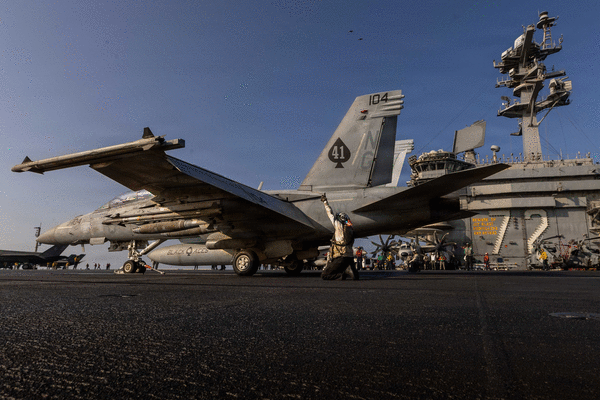
The U.S. and Iran intensified their attacks beyond military targets during a sixth straight day of hostilities, increasing fears of a return to full war with no agreement reached over the Strait of Hormuz.
The U.S. hit southern Iran overnight, striking six road bridges, according to Iranian state media. There were separate reports of attacks on the southern town of Bushehr, which houses the country’s only nuclear power plant, and the western province of Lorestan.
Iran’s Ministry of Energy called on households to limit air conditioning due to southern provinces facing “extreme heat and attacks on power-supply facilities,” the semi-official Iranian Students’ News Agency reported.
Iran responded by firing on U.S. bases in Kuwait, Jordan and Bahrain — the three countries that have borne the brunt of the Islamic Republic’s counterstrikes since fighting picked up early last week — and on Oman’s As Salamah Archipelago, which sits on the strait.
Kuwait reported strikes on a water desalination and power generation plant, causing a fire and damage. Qatar, one of the main mediators between Washington and Tehran, said it intercepted incoming missiles.
China and Pakistan expressed concern over the developments, calling on both the U.S. and Iran to cease hostilities and resume dialogue.
The worsening hostilities, triggered by Iran attacking tankers going through the Strait of Hormuz, are still far from the scale seen at the height of the war in March and early April. Then, the U.S. and Israel were bombarding Iranian cities on a mass scale and Tehran was firing thousands of drones and missiles at Gulf Arab states and Israel.
Yet with Iran continuing maritime attacks and insisting all ships seek its permission before sailing through the strait, there’s a good chance both sides continue to escalate, according to Mehran Kamrava, a professor of political science at Georgetown University in Qatar.
The attacks are “an ominous sign of more to come, worse to come,” Kamrava told Bloomberg TV on Friday from Doha. “Neither side wants to see this escalation but both have become dependent on the path of an escalatory cycle from which they cannot back out. This tit-for-tat is now very dangerous in the sense of attacks and counter attacks on critical infrastructure.”
The U.S. military says its strikes, focusing largely on Iranian infrastructure such as radar, missile and drones sites, are designed to end Iran’s stranglehold over Hormuz and ease the transit of oil and liquefied natural gas tankers and other ships critical to the global economy. Iran says they’ve gone beyond military targets to hit civilian infrastructure.
For now, the heightened tensions are making shippers more wary, and traffic through the waterway has slumped in the past 10 days.
Beyond bombing Iran more often, the U.S. is again blockading its ports and has scrapped a waiver for sanctions on its oil exports, both concessions made as part of an interim peace deal signed last month. Talks over Iran’s nuclear program, which were meant to be happening over a 60-day period following the agreement, have all but stopped.
U.S. President Donald Trump threatened earlier in the week to step up military operations until Iran relents on Hormuz.
The Islamic Republic’s military has warned if he follows through on a pledge to hit bridges and energy sites, “everything that has remained intact so far due to Iran’s nobility will be smashed to pieces.”
“Tehran sees the strait as critical leverage, and won’t give it up,” said Bloomberg Economics analysts Becca Wasser and Dina Esfandiary. “The U.S. also won’t fold — it wants to ensure freedom of navigation and the continued flow of oil. That means more clashes and the prospect of a dangerous escalation spiral, even if both still want to avoid high-intensity war.”
Crude oil prices rose on Friday, with Brent at close to $86 at barrel, having gained 11% this week. Refined fuel has also jumped. U.S. gasoline pump prices are almost back to $4 a gallon, a potential blow to Trump ahead of midterm elections in November. Dubai’s stock market is down the most this week since around mid-May.
Commercial traffic through the Strait of Hormuz has largely been limited in recent days to Iran-linked vessels using the northern route approved by Tehran, ship-tracking data compiled by Bloomberg show. Some other oil cargoes continue to cross without broadcasting their location, though in small numbers.
Two supertankers carrying Saudi and Iraqi crude reappeared off Oman late Wednesday after going dark on tracking systems in the Persian Gulf over the weekend, indicating they likely completed the Hormuz passage earlier this week.
The slowdown has pushed the seven-day moving average of crude oil flows, including Iranian supplies, through Wednesday down to about 5.5 million barrels a day, from around 9.4 million the previous week, according to Bloomberg calculations based on vessel-tracking data and information from Kpler and Vortexa.
“Iran and the U.S. are likely to maintain dialogue despite the flareup as both seek to strengthen their respective negotiating positions,” wrote Torbjorn Soltvedt, the main Middle East analyst at risk-intelligence company Verisk Maplecroft. “But given the standoff over shipping in the Strait of Hormuz, there is now a significant risk of escalation and renewed attacks on regional energy infrastructure. Pressure on international oil prices will continue to climb.”
—With assistance from Shruthi Rajendran and Dana Khraiche.
©2026 Bloomberg L.P. Visit bloomberg.com. Distributed by Tribune Content Agency, LLC.






Comments