Amazon and NYC Mayor Mamdani clash over proposed delivery partner bill
Published in Business News
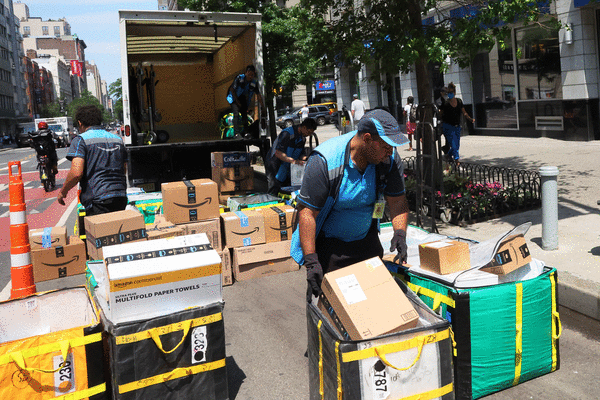
A fight over who bears responsibility for the people delivering Amazon packages to doorsteps is once again erupting — this time in New York City.
New York City Mayor Zohran Mamdani has voiced his public support for a bill that would require Amazon and other companies to directly employ, rather than subcontract, delivery workers.
“It's time for a change,” he wrote in a social media post this month. “I'm proud to support the Delivery Protection Act to crack down on exploitative subcontracting and build an economy that works for everyone.”
The bill, which has stalled in the New York City Council for nearly a year, would arguably strengthen delivery worker protections. But it also would upend a key part of Amazon’s delivery model in a congested city grown reliant on doorstep drop-offs.
In response, the Seattle-based e-commerce giant has said it would consider moving delivery operations and facilities outside the city if the bill moves forward and has spent millions opposing it.
Amazon spokesperson Kelly Nantel said in a statement this week that the company is committed to its delivery service partners and “creating good jobs.”
“But as written, this legislation would directly undermine that commitment — threatening the small businesses that deliver to customers, putting the jobs of more than 5,000 of their employees at risk, and forcing us to consider relocating delivery operations outside of the city,” the spokesperson said.
The bill would require distribution facility operators, such as Amazon, to directly employ delivery workers who traverse city streets in vans and on bikes to drop packages off at their final destinations.
The legislation would also require operators to obtain city licenses and establish minimum safety, training and worker-protection standards. For each delivery worker retained as a nonemployee, a company such as Amazon would have to post a $500,000 bond, which would go toward people injured in road accidents.
The debate is not new. In the past few years, delivery partners in different markets accused Amazon of setting unrealistic expectations for drivers, resulting in traffic accidents and on-the-job injuries, while shielding itself from liability.
In 2021, two of Amazon’s delivery service partners in Beaverton, Ore., and Vancouver, Wash., sued Amazon in Multnomah County Circuit Court, claiming they couldn’t manage the business profitably or deliver packages safely under the company’s demands. The following year, a Wyoming delivery company filed a similar lawsuit in U.S. District Court in Seattle, taking it a step further by seeking class action status.
These three cases were resolved outside of court.
New York City’s solution
The proposed Delivery Protection Act would ban Amazon’s subcontracting model altogether.
“Corporations like Amazon build billion-dollar business models by insulating themselves from accountability through a system of exploitative subcontracting,” Mamdani said. “New Yorkers should not be forced to subsidize corporate profits with less safe streets and more precarious jobs.”
The Office of the New York City Comptroller, which acts as a watchdog, issued a report shortly after Queens Councilmember Tiffany Cabán introduced the bill last year that linked worsening traffic safety in the city to the emergence of “last-mile” package delivery facilities — the last distribution centers packages arrive at before workers deliver them to doorsteps.
Since 2017, 18 of those facilities have opened citywide, according to the report. Around three-quarters of nearby areas saw more injury-causing crashes, with injuries within a half-mile radius of last-mile facilities rising by an average of 16%, according to the report.
City officials argue Amazon’s delivery quotas for its subcontracted delivery drivers create intense time pressure, contributing to the increased traffic accidents and injuries.
Amazon, on the other hand, says its more than $2.5 billion investment in technology and training since 2019 has improved safe driving in measurable ways. That technology includes camera-based systems that use artificial intelligence to alert drivers to unsafe driving.
In its testimony, Amazon said the serious crash rate in New York City improved by 35.7% from 2024 to 2025.
Despite Amazon’s steps, city officials believe the current delivery model incentivizes the company to continue pushing excessive delivery quotas on workers because it isn’t liable for injuries or traffic accidents — the delivery service provider is.
“By shielding themselves behind these so-called independent operators, this trillion-dollar company is able to avoid regulations on our city streets,” Cabán said in a video posted to Mamdani’s social media earlier this month.
Amazon has fought back fiercely, casting its opposition as a defense of small delivery businesses.
Amazon has funneled over $5 million into a lobbying group called the Five Borough Jobs Campaign, which runs ads opposing the bill. The group said a study it commissioned found the bill’s passage would increase the cost of delivery in New York City by as much as $5.20 per package on average, or $664 annually per household.
The threat of departure and increased costs have fueled mixed public opinions on the bill — in New York City and beyond.
Chicago appears to be the only other major U.S. city to propose similar legislation to New York City’s. But it’s a safe bet to say city leaders nationwide will be watching the impact of the bill in New York City should it pass after such public drama.
For now, however, it’s continued to stall. No official vote has been scheduled, although a majority of the New York City Council supports the bill.
©2026 The Seattle Times. Visit seattletimes.com. Distributed by Tribune Content Agency, LLC.








Comments