He saw so much single-use, soft plastic lying around, this nonprofit founder wanted to clean it up
Published in News & Features
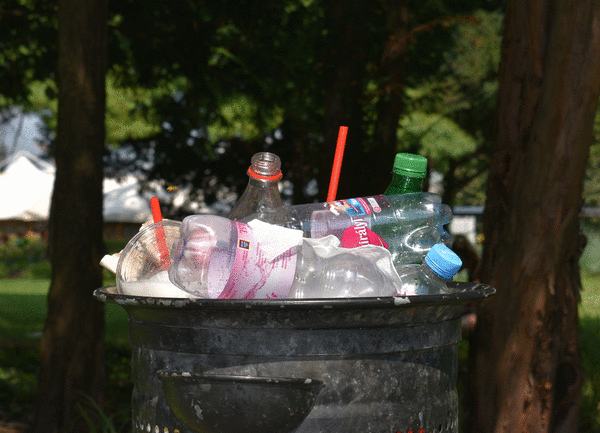
California companies that produce single-use packaging and plastic single-use food service ware have until Monday to comply with some of the terms of the Plastic Pollution Prevention and Packaging Producer Responsibility Act (SB 54).
They can participate in an approved producer responsibility organization plan by registering with Circular Action Alliance and submitting the required information; they can comply individually by registering with CalRecycle and applying to be an independent producer; or they can register with CalRecycle to apply for a small producer exemption, according to CalRecycle, the state’s Department of Resources Recycling and Recovery. This bill was signed into law in 2022 to reduce the impact of these types of single-use plastics by requiring that, by 2032, the use of these materials are cut by 25%, that 65% are recycled, and 100% of these single-use items are recyclable or compostable.
For Matthew Clough, founder and director of the San Diego nonprofit Plastic Beach, which provides soft plastic collection and recycling services, this work continues to be an exciting opportunity. His organization is running a five-month pilot program for small businesses from San Diego to Los Angeles, funded by the Circular Action Alliance. Starting July 1, Plastic Beach will provide bins, pickups, and processing to participating business, free of charge, and send the collected flexible plastic to recyclers and manufacturers within the United States for reuse.
“The portion we’re doing is aimed at small- to medium-sized businesses. The idea is that we basically provide a free recycling service for (five) months to local companies, and they get to use it to understand how much plastic they have,” he says. “A lot of it is to do with educating and behavior change and stuff like that, so we see this as an awesome opportunity to really get them to understand because you can’t really make a decision if you don’t understand the problem.”
Clough, who lives in Encinitas with his wife, Veronika, and their two rescue cats, also has two adult children and started Plastic Beach in 2019, after earlier careers as a police officer in Hong Kong, an EMT and paramedic in London, and a stay-at-home dad. This work to help improve the environment allows him to care for others and make the world better for his kids. He took some time to talk about his work and the issue of recycling and reducing soft, flexible plastics.
Q: Help people understand the distinction between soft plastics and hard plastics.
A: We have a literal rule of thumb — if you can stretch the plastic between your thumbs, it’s soft plastic. That could be the heavier duty, so-called reusable grocery bag, down to the thin Ziploc bag, bubble wrap, or pallet wrap. The only caveat is if you think about the produce bags at a grocery store, there is a small amount of what’s labeled as biodegradable, and all compostable plastic packaging out there now.
Q: For people recycling at home, why can’t those plastic grocery bags go in their blue, curbside bins for recycling with materials like cardboard?
A: It’s a system issue, basically. The systems that we have in place for the people that are running your recycling program, when they pick it up, it all goes into your blue bin and gets dumped into the main truck. That main truck goes to the recycling facility where it’s basically emptied into a hopper. Then, it gets sorted. The problem with flexible plastic is that it’s very light, so it can get pulled into the gears and the wheels on the conveyor belts. Because everything’s dumped on the conveyor belt, and then there’s another truck waiting behind it to dump its load, everything has to flow. These haulers are basically saying that their system can’t cope with it, and instead of us pivoting to create a system to cope with it, as a society we accepted that excuse. There’s never been a solution for this material, and that’s really what we’re trying to build. We’re proving that companies are interested in doing this. We’ve got 50 clients we’re working with and they’re showing how straightforward it is to get this material into its own container at the client site, and that’s what we do.
Q: Why do you think it has been so difficult to get people to see why this is such a problem?
A: I think there’s a couple of issues. One issue in California is that the (single-use plastic) grocery bag has sucked the oxygen out of the room when it comes to talking about plastic bags and flexible plastics, which actually covers things from pallet wrap, bubble wrap, plastic shipping envelopes, the bags that nearly all of our clothes arrive at the store, dry cleaning bags, and on and on. A lot of those we don’t see as the general public because it’s all taken off when it arrives at the store or at the factory. The example I use is that a vehicle doesn’t come to you whole, but it comes to the factory in 10,000 different pieces and those pieces are all associated with either little plastic baggies for the nuts and bolts, bubble wrap for the more sensitive parts like the circuit boards, or pallet wrap for the large parts. I use that example because it’s completely hidden to us, and most of us don’t know, so it’s hard to comprehend all this plastic that is associated with our lives. The second point is there’s a really strong level of denial where people don’t want to accept the amount of plastic that’s in their lives that they’re not directly associated with. That’s one of the things we’re trying to change. We’re all consumers, by definition, whether we’re buying food, water, clothes for our kids; most of those products have plastic that we can’t control. It comes to the store in plastic, we don’t have any agency over that, so we really need to look at how do we deal with it. Because of the grocery store legislation and everything, whenever we mentioned plastic bags, pretty much to anyone, they mostly go to the grocery bags, but there’s 141 million tons of soft plastic packaging produced every year, globally (according to information from 2024 from nonprofit Clean the World). So, we’re taking this very pragmatic approach that this material is coming, it’s been fire-hosed out, and it’s just ending up in landfills because the haulers are saying that they can’t take it because it gets sucked into their conveyor lines. Faced with a system that’s been ignored, we’re showing that it is actually very simple to set up these collection networks and get this moving forward.
Q: How is Plastic Beach working to get this flexible plastic recycled properly?
A: There are some really cool companies that use the recycled plastic bags in what’s called downcycling, so they’re making a different product from it. The main company we’re working with is a company called Trex, and they make composite decking. We are a community partner for them, which means that we’re allowed to send our plastic to them. There are also companies that make asphalt using recycled plastic. That’s very relevant because it means that not only does this material not have to go to landfill, but it can actually solve a pressing need that we have. We’re pushing for what we call a city circular model that we’ve built. Imagine all the plastic collected from San Diego businesses ended up going back into its roads. That’s way more equitable than decking because not everyone has a yard, let alone a space to put up a deck. That asphalt could be the school parking lot, it could be the ER parking lot, it could be just keeping it within your city. That’s my goal as a company, and that’s why I would love to get us to where we can persuade one city to really look at that and see it as a solution.
It helps businesses that either have diversion targets set by corporate, or they feel individually, as business owners, that they don’t feel comfortable throwing all this stuff away. We are also keeping the solution domestic, which is a big deal to me because we’re not offshoring our waste. We’re also creating three to four layers of American jobs in the process of keeping this out of landfills, so we’re trying to hit multiple benefit points, the big one being that we are basically sequestering hundreds of tons of microplastics out of the environment for the next 40 to 50 years, instead of it just going straight into a landfill. I feel that the more material that we can divert away from landfills, even if the stuff we’ve diverted only buys landfills an extra day or week or whatever, there is absolutely a price associated with that and that’s the value that I’m trying to get across to our community.
_____
©2026 The San Diego Union-Tribune. Visit sandiegouniontribune.com. Distributed by Tribune Content Agency, LLC.





Comments